

Opening: The First Minutes Decide a Lot
Picture a night shift at an underground mine. A conveyor operator notices a thin line of smoke near the belt. The radio crackles, three people in different locations hear different pieces of the same story, and each must decide what to do first: report, isolate, or move. What happens next depends less on the thickness of the emergency binder than on whether people have practiced recognizing the signs, communicating clearly, and following their procedures under stress.
The same pattern appears at surface operations: a haul truck driver with limited visibility near pedestrians, a slope that starts to show new cracks, a radio network that drops out between work areas. Having a written emergency response plan is necessary. Knowing that crews can actually execute it is another question.
VR mine safety training is one way to narrow the gap between knowing a procedure and performing it. This article explains what VR safety simulation is, which emergency scenarios suit it, how to evaluate results, how it connects to 3D models and BIM, and what risks to manage, without overstating what the technology can do.
Executive Takeaways
- Business problem: Conventional emergency training is hard to repeat, costly to stage, and limited in how safely it can recreate dangerous conditions.
- Role of VR: Virtual Reality (VR) provides an immersive 3D environment where workers rehearse decisions and responses without exposure to real hazards. It complements field drills; it does not replace them.
- Relevant scenarios: Fire and smoke, ventilation problems, ground failure, heavy equipment incidents, communication breakdowns, hazardous spills, first response to injury, and evacuation route selection.
- Measuring results: Track action accuracy, hazard recognition time, procedural sequence, and before-and-after assessments, with targets set by your own organization.
- Success factors: Alignment with risk assessments and SOPs, HSE expert validation, technical support, data protection, and integration into recurring training.
- Recommended first step: A limited pilot built around one high-risk scenario with a validated procedure.
Why Conventional Mine Safety Training Hits Limits
Classroom sessions, inductions, hands-on instruction, and field drills remain the backbone of any safety program. They also have known constraints:
- Risk in physical simulation. Dense smoke in a tunnel or an equipment interaction event is difficult or unsafe to stage for real.
- Cost and preparation time. Full-scale exercises require scheduling, people, equipment, and often interrupt production.
- Limited repetition. Large drills cannot be run as often as skill-building requires.
- Realism. Reproducing low visibility, noise, or changing site conditions safely is hard.
- Uneven experience. Workers arrive with different backgrounds, so a single format may not fit everyone.
- Hard-to-assess decisions. Observing and recording why someone chose a particular action is difficult.
- Cross-team coordination. Exercises involving operations, HSE, contractors, and emergency teams are complex to organize.
Research from the U.S. National Institute for Occupational Safety and Health (NIOSH) notes that full-scale mine emergency response drills are immersive but expensive and resource-intensive, which limits how often teams can run them. Field drills, practical exercises, and instructor-led training remain essential and cannot be fully replaced by VR.
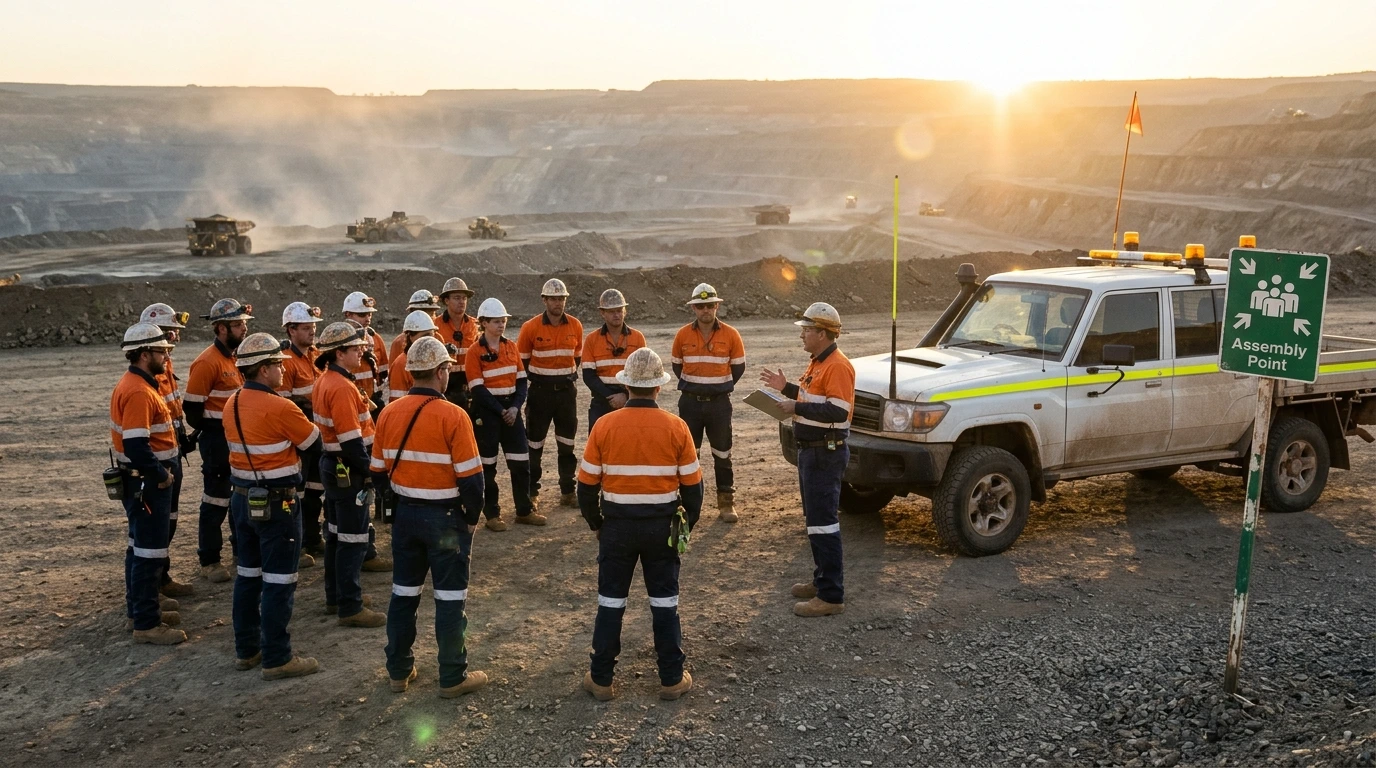
Field drills stay essential, but they are hard to repeat and costly to prepare.
What Is VR Safety Simulation?
Virtual Reality (VR) places a user inside a computer-generated 3D environment through a headset, letting them look around and interact with objects using controllers or motion tracking. VR safety simulation applies this to rehearsing decisions and actions in hazardous situations with no exposure to real danger.
How it differs from a safety video. A video is passive. In VR the participant must act: choose a route, use equipment, make a report, set priorities. The scenario then responds to those choices.
Core components include the headset and controllers, scenario software, a 3D model of the work area, interaction logic (what happens when a participant selects a given action), and a results-logging module. An instructor or operator prepares the scenario, briefs participants, observes (often via a screen mirroring the trainee's view), and leads the debrief.
Because scenarios can be re-run, participants can practice repeatedly and compare their decisions. A quick comparison of related terms:
- VR: the user is fully inside a virtual environment.
- Augmented Reality (AR): digital information is overlaid on the real-world view.
- Digital twin: a digital representation of a real asset or process that, where needed, is connected to live data. It is not a synonym for VR, though VR can be one way to visualize it.
VR does not automatically guarantee safety or eliminate accidents. Its value depends on scenario quality, evaluation, and how well it fits the wider safety program.
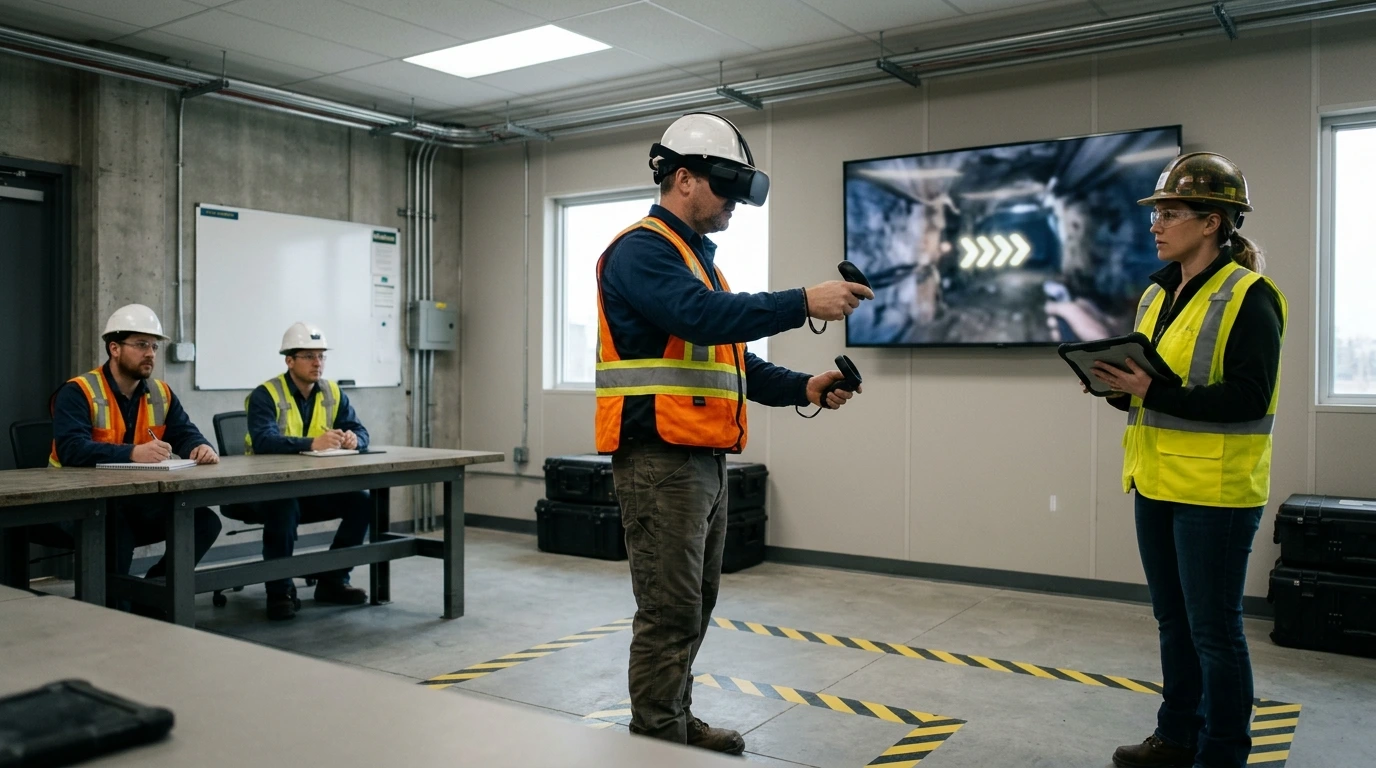
The instructor watches the trainee's view and leads the debrief afterwards.
Emergency Scenarios Suited to Simulation
Scenarios must reflect each mine's characteristics, risk assessments, SOPs, and applicable regulations. The examples below are illustrative and must be adapted.
| Scenario | Participant Decisions | Training Objective | How the Instructor Evaluates | Limits and Follow-up |
|---|---|---|---|---|
| Fire and smoke | Report, choose exit route, use equipment per SOP | Initial response and evacuation | Sequence of actions, response time, route choice | VR cannot reproduce heat or physical strain; follow with field drills |
| Ventilation failure or hazardous atmosphere (underground) | Recognize signs, use protective equipment, reach safe location | Hazard awareness and protective procedures | Accuracy of identification and procedural compliance | Hands-on practice with real equipment still needed |
| Ground failure, falls of ground, changing work area conditions | Stop work, move away, report | Alertness and stop-work decision | Speed of recognition and reporting accuracy | Real geotechnical data remains the reference |
| Heavy equipment incident and human-vehicle interaction | Choose safe position, signal, stop operations | Managing interaction and exclusion zones | Position accuracy and communication | Practice with real operators and vehicles |
| Communication and coordination failure | Use backup channels, relay key information | Team coordination when comms are degraded | Clarity and accuracy of messages | Test real communication equipment |
| Hazardous spill (where relevant) | Secure area, report, use PPE | Initial response and area control | Procedural sequence compliance | Technical handling by competent personnel |
| First response to an injured worker | Assess scene, call for help, avoid adding risk | Initial aid and escalation | Priority-setting and reporting | Certified first aid training remains mandatory |
| Evacuation routes and assembly points | Select route, assist colleagues, report at assembly point | Route accuracy and personnel accountability | Route chosen, time, completeness of reporting | Regular physical verification of routes |
For each scenario, document the simulated situation, expected decisions, the procedure being trained, how it will be assessed, and the limits of the simulation.
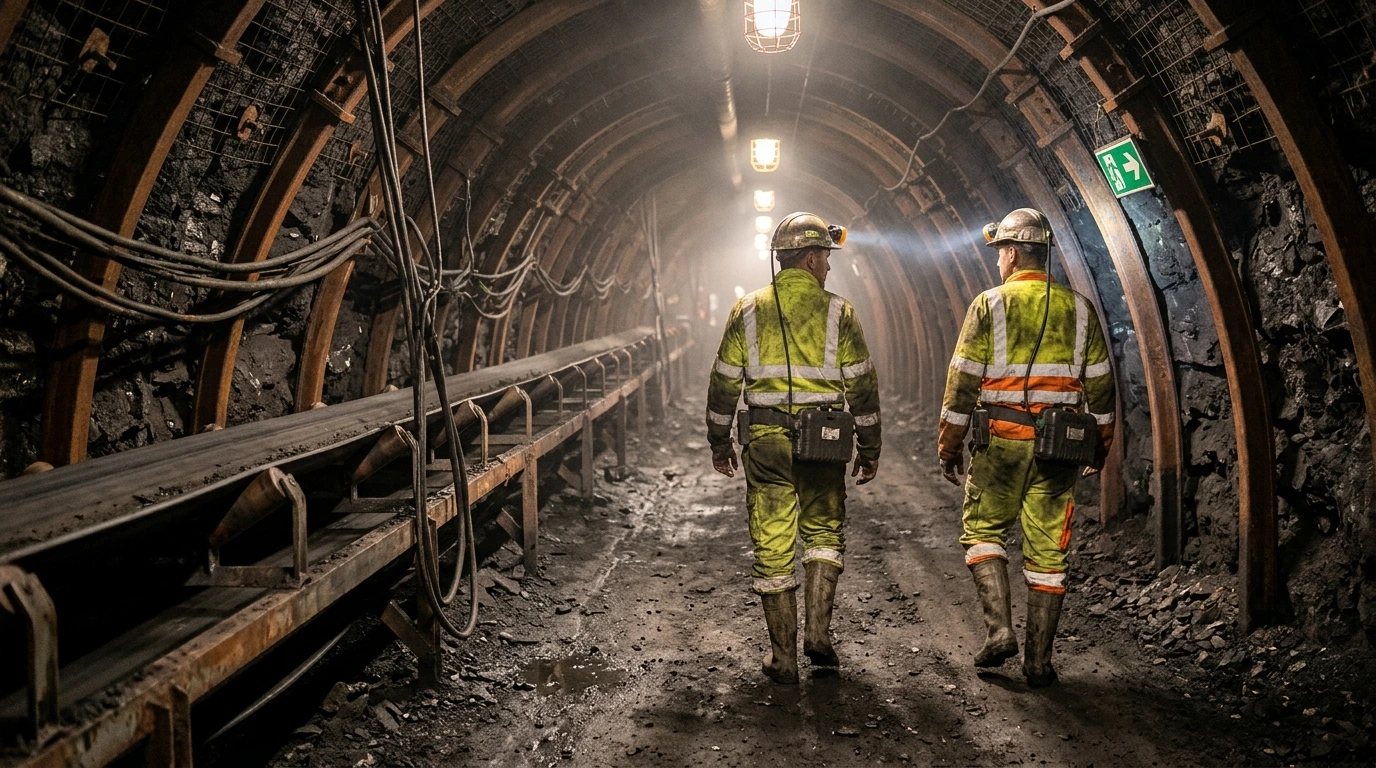
Scenarios are built so participants make decisions rather than watch hazards.
How a VR Safety Training Program Is Delivered
Good implementation starts from needs, not hardware. A workable sequence:
- Identify hazards and training needs from risk assessments and internal incident data.
- Map SOPs and emergency response procedures to be trained.
- Select priority scenarios by risk and consequence.
- Collect site data and visual references, such as engineering drawings, photos, and plans.
- Build the 3D environment.
- Develop interactions and scenario logic.
- Run technical tests and expert HSE validation.
- Deliver training with participant briefings.
- Collect evaluation results.
- Refine scenarios and integrate into recurring training.
Suggested roles: management provides mandate and resources; the HSE team sets training goals and assessment criteria; instructors run sessions and debriefs; operations teams ensure scenarios reflect real work conditions; technology developers build and maintain the environment and logic.
Connecting VR, BIM, 3D Visualization, and Digital Twins
Building Information Modeling (BIM) is a process and digital model that holds geometry and attribute information about a facility or infrastructure. A digital twin is a digital representation built for a defined purpose and, where needed, linked to actual data. They are not the same: BIM can be a source or reference, while a digital twin requires suitable data and integration.
As a conceptual example, a BIM model of a processing plant, workshop, or stockpile area could serve as the geometry reference for building a simulation environment, such as evacuation routes, emergency door locations, and visual obstructions. Possible relationships include:
- Engineering drawings and BIM models provide dimensions and layout.
- 3D environment modeling turns that reference into an explorable space.
- Visualization of work areas helps operations teams validate accuracy.
- A digital twin, if the data and integration exist, can add context on actual conditions.
- Training results can be analyzed to improve scenarios.
This section is conceptual. Specific capabilities or service scope should be confirmed directly with any provider before they inform a decision.
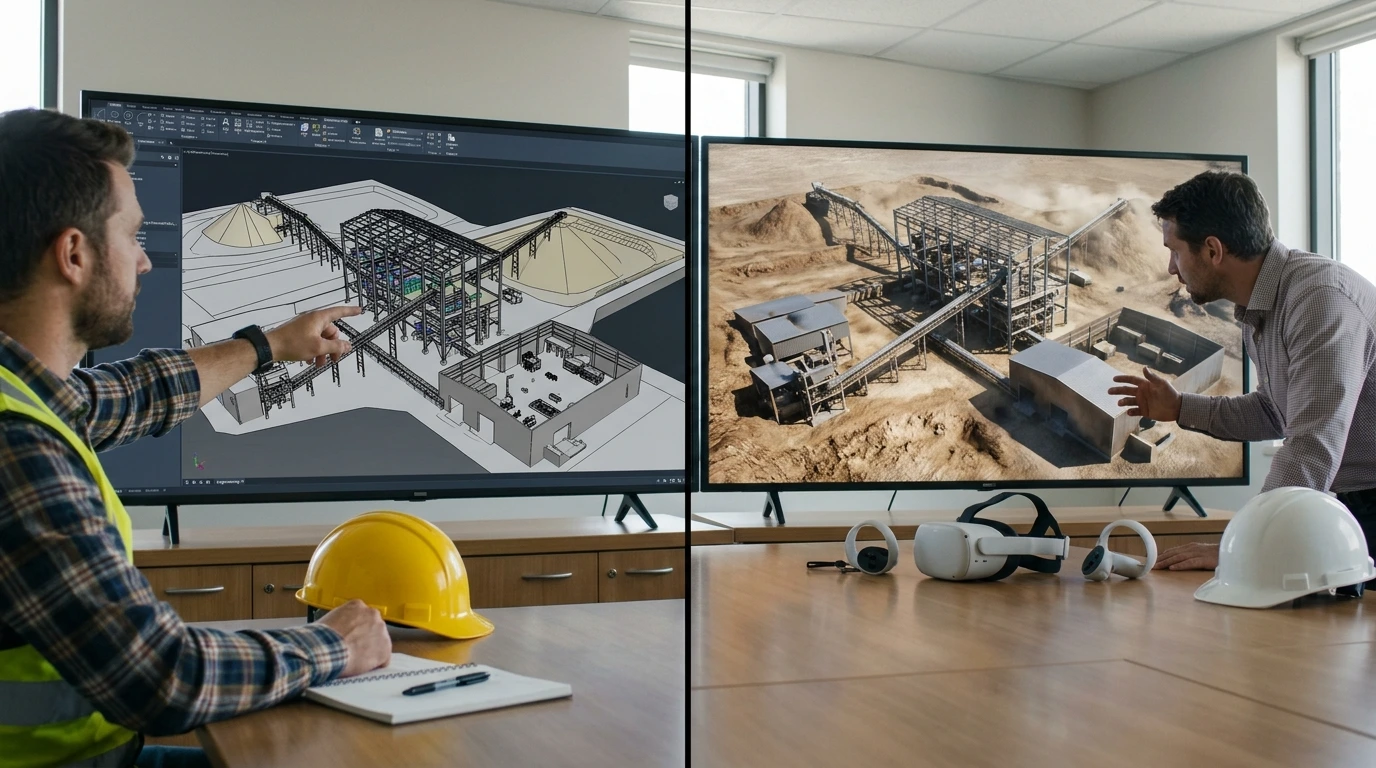
A 3D facility model can serve as a reference for building the simulation environment.
Business Value and Evaluation Metrics
Benefits should be measured, not assumed. A systematic review and meta-analysis of VR for safety training (Scorgie et al., Safety Science, 2024) found that VR can outperform traditional training for knowledge acquisition and retention, while also noting that only a minority of reviewed studies reported long-term retention. A separate review in the journal Virtual Reality (2023) found that most studies assess learning and reaction, with far fewer measuring behavior or organizational results. In practice, organizations need to design their own evaluation.
| Indicator | How to Measure | Evaluation Purpose | Interpretation Notes |
|---|---|---|---|
| SOP understanding | Pre- and post-training test | Assess mastery of procedures | Keep difficulty equivalent; do not use as the only measure |
| Action accuracy | Decision log in the simulation | Assess decision quality | Compare with answers agreed by HSE experts |
| Hazard recognition and response start time | In-scenario timers | Assess initial response speed | No universal benchmark; set internal baselines |
| Procedural sequence compliance | System or instructor checklist | Assess procedural discipline | A different order is not always wrong; review context |
| Evacuation route accuracy | Chosen route versus reference route | Assess layout knowledge | Update when mine layout changes |
| Communication and coordination quality | Instructor observation with a rubric | Assess team coordination | Subjective; use a written rubric and consistent raters |
| Scenario completion rate | Share of scenarios completed | Assess overall readiness | Affected by scenario difficulty |
| Knowledge retention | Re-test after a delay | Assess long-term recall | Interval must be set by the organization |
Indicators must be adapted to scenario types and company procedures. This article deliberately gives no numeric targets or improvement claims, because there is no data from your operation to support them.
ROI components. For a cost-benefit comparison, count hardware, content development and updates, licensing, maintenance and technical support, and instructor and participant time, against field exercise costs that may be reduced, preparation time saved, and the measured value of improved readiness. Results depend on each mine and cannot be promised as a specific figure.
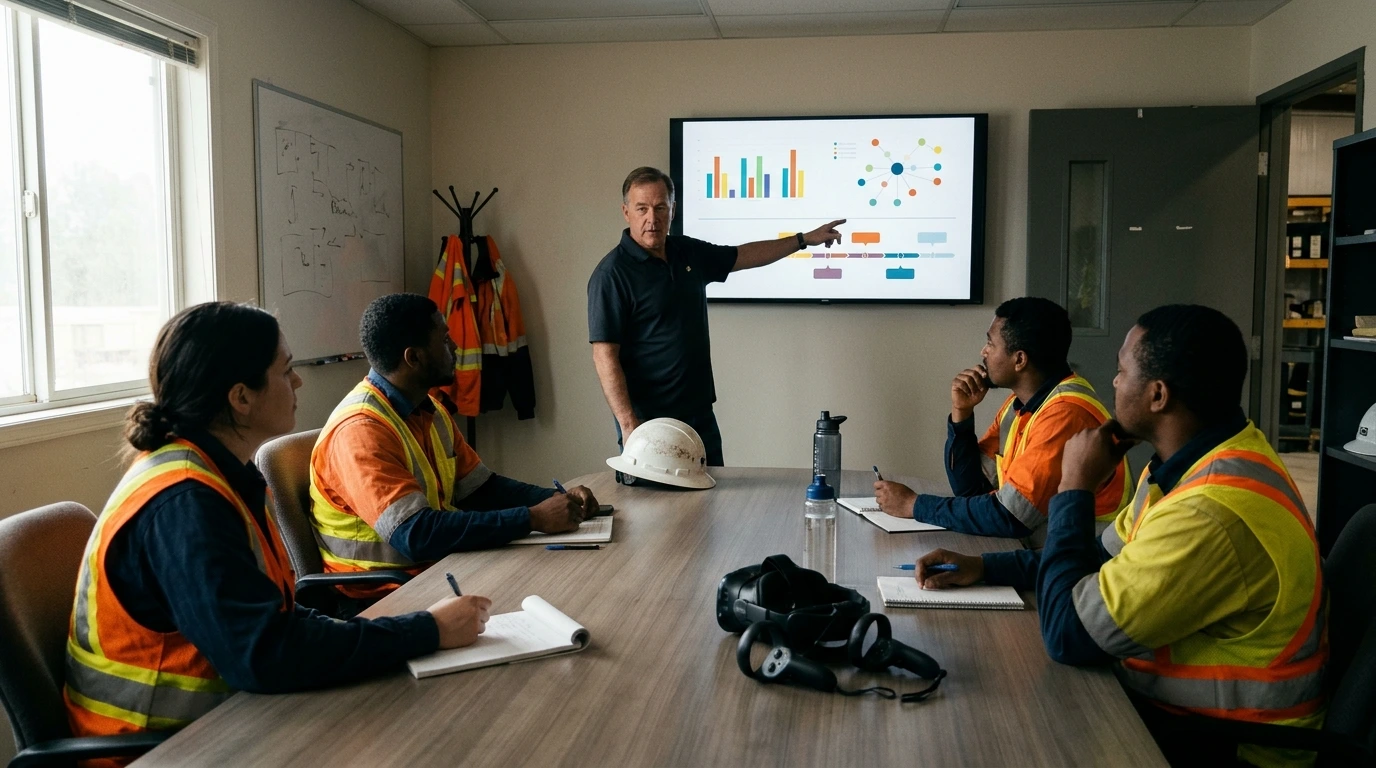
Simulation data supports debriefs and scenario refinement.
Challenges, Risks, and Success Factors
- Investment. Hardware and content development require budget; NIOSH researchers list cost, portability, user acceptance, fit with existing programs, and limited industry collaboration among barriers to VR adoption in mining.
- Scenario upkeep. SOPs and site conditions change; scenarios must be updated with them.
- Motion sickness. Some participants feel unwell; use short sessions, allow stopping, and offer alternatives.
- Hygiene and ergonomics. Headsets are shared; set cleaning routines and fit adjustment.
- Accessibility. Consider participants with visual or mobility limitations or low comfort with technology.
- Privacy and data. Training results are personal data; decide who can see them, how long they are kept, and where.
- Spares and support. Keep backup devices and a support channel so schedules are not disrupted.
- Competent validation. Scenarios should be reviewed by qualified HSE personnel.
- Field practice as a complement. The best outcomes come from combining VR with real-world practice.
A phased approach through a pilot project is recommended before wider rollout.
Checklist: Choosing a VR Solution for Mining
- ☐ Relevance to your mine's risk profile
- ☐ Scenarios can be adapted to company SOPs
- ☐ Sufficient realism and interactivity for the training goal
- ☐ Easy for participants and instructors to use
- ☐ Participant evaluation and results recording
- ☐ Content can be updated when procedures change
- ☐ Compatible with the selected devices
- ☐ Clear data security and storage
- ☐ Technical support and maintenance available
- ☐ Can integrate with 3D models or technical data if required
- ☐ Total cost of ownership understood (devices, content, updates, support)
Implementation Roadmap
This roadmap is conceptual. Any durations mentioned are illustrations to be adjusted.
| Phase | Activities | Parties Involved | Expected Output |
|---|---|---|---|
| 1. Assessment and prioritization | Review risks, SOPs, training needs, infrastructure readiness | Management, HSE, operations, IT | Priority scenario list and success criteria |
| 2. Proof of concept / pilot | Build one scenario, test with a small group | HSE, instructors, developers, HSE experts | Validated pilot scenario and initial data |
| 3. Evaluation and refinement | Analyze results, gather feedback, revise | HSE, instructors, participants, developers | Go / adjust / stop recommendation |
| 4. Expansion and maintenance | Add scenarios, schedule recurring training, update content | Management, HSE, training, developers | Integrated training program and maintenance plan |
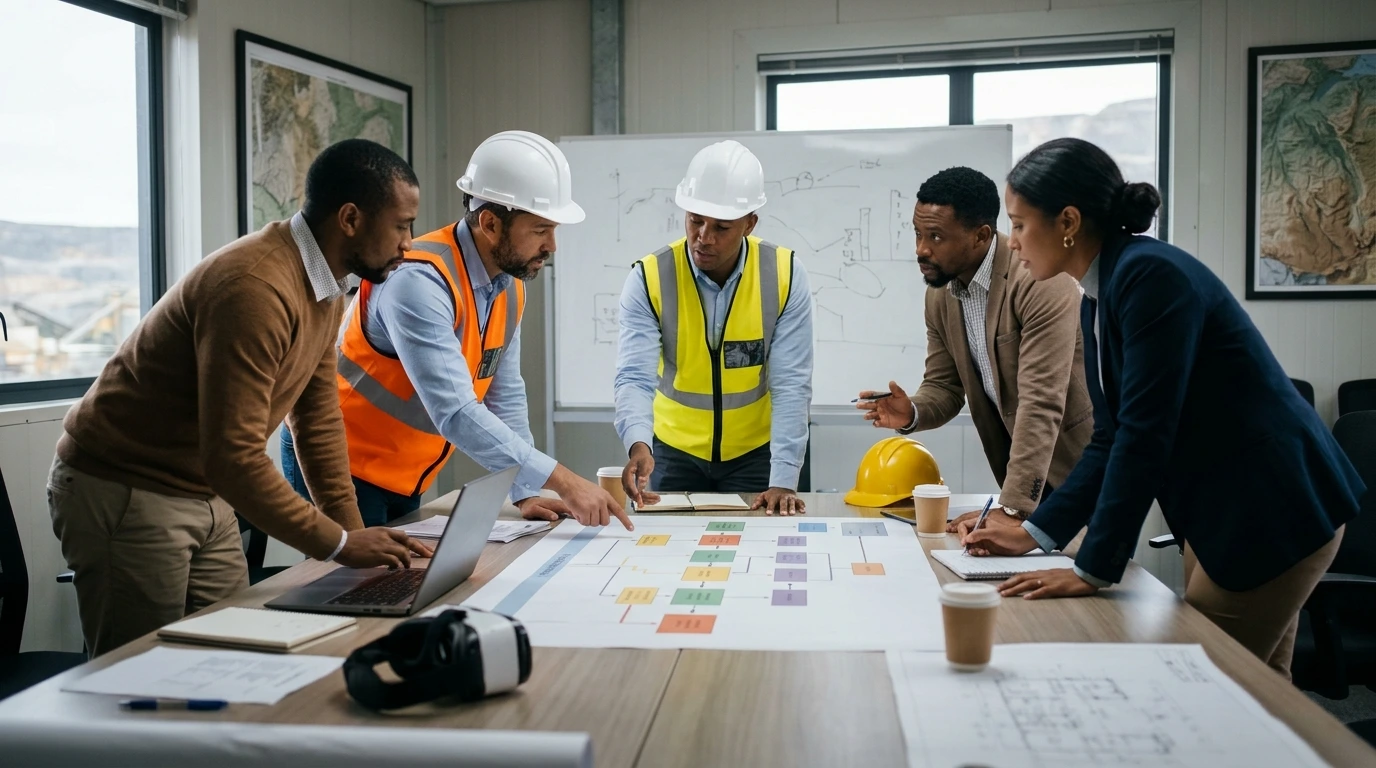
A phased rollout starts with a pilot built around one priority scenario.
Regulations and Standards to Check
VR programs must align with the rules where your mine operates. In Indonesia, the guideline for good mining engineering practice is set by Ministry of Energy and Mineral Resources Decree No. 1827 K/30/MEM/2018. In Japan, mine safety is governed by the Mine Safety Act (鉱山保安法) and its enforcement regulations under the Ministry of Economy, Trade and Industry (METI), whose enforcement regulations were amended in July 2025. Internationally, the ILO Safety and Health in Mines Convention, 1995 (No. 176) is a key reference, and ICMM publishes Critical Control Management guidance for managing the controls that matter most in preventing serious events. Requirements differ by jurisdiction, mine type, and date. Check current versions and consult competent authorities or compliance advisors before deciding.
Conclusion
VR has the potential to complement a mine safety program by offering immersive, repeatable, and measurable practice, especially for conditions that are difficult or unsafe to stage in the field. The best results depend on scenarios that match real risks, validation by HSE experts, clear evaluation indicators, and a combination with field training. A phased pilot lets organizations learn before committing to larger investment.
Fujicon can be a discussion partner for BIM, 3D visualization, and related digital solution needs, based on services that can be confirmed in consultation.
Evaluating BIM, 3D visualization, or digital technology to support your mining operations? Visit https://bimsolusi.fujicon.id to learn about Fujicon's solutions, or discuss your project needs via WhatsApp at https://wa.me/6281122275222.
Fujicon Priangan Perdana
- WhatsApp: +62 811 2227 5222
- Website: https://bimsolusi.fujicon.id/
References
- Bellanca, J. L., & Hoebbel, C. L. Pre-Implementation Evaluation of VR as a Mine Safety Training Tool. CDC/NIOSH
- Orr, T. J., Mallett, L. G., & Margolis, K. A. Enhanced Fire Escape Training for Mine Workers Using Virtual Reality Simulation. SME Preprint 09-126 (2009)
- Scorgie, D. et al. (2024). Virtual reality for safety training: A systematic literature review and meta-analysis. Safety Science, 171
- Evaluating the effectiveness of virtual reality for safety-relevant training: a systematic review. Virtual Reality, 27(4) (2023)
- ICMM. Critical Control Management
- ILO. C176 - Safety and Health in Mines Convention, 1995 (No. 176), NORMLEX
- Kementerian ESDM RI. Keputusan Menteri ESDM Nomor 1827 K/30/MEM/2018 tentang Pedoman Pelaksanaan Kaidah Teknik Pertambangan yang Baik
- 経済産業省「鉱山保安法令の概要」(令和2年11月)
- 経済産業省「鉱山保安法施行規則の一部を改正する省令…について」(令和7年7月7日)