

For many manufacturing companies in Indonesia, production management is still operating in a semi-manual manner: work order records on paper or spreadsheets, raw material stock information that is updated late, and production line efficiency reports that can only be viewed at the end of the month. As a result, production decisions are often made based on assumptions rather than actual data on the ground. This is where ERP (Enterprise Resource Planning) based production management becomes a necessity, no longer just an option.
With an integrated production ERP system, every stage—from raw material planning, work order execution, to machine capacity evaluation—is recorded in real-time and can be measured with clear numbers. This article discusses five key areas where ERP makes production management much more measurable, planned, and efficient.
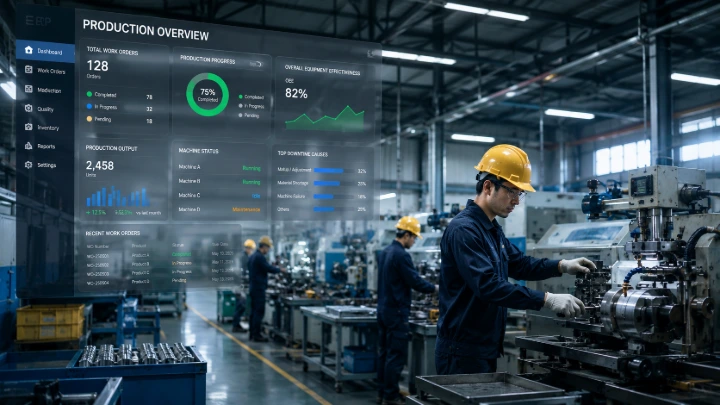
1. More Planned Production
Good production planning starts with accurate data: Bill of Material (BOM), production routes, and demand forecasts. In an ERP system, these three elements are automatically interconnected. When there is a new sales order, the system can immediately calculate the raw material requirements, estimate production time, and create a work schedule without needing to be recalculated manually by the PPIC team.
The Material Requirement Planning (MRP) module in ERP also helps companies avoid two classic problems in production management: stock shortages that halt production lines, and excess stock that burdens storage costs. With more structured production planning, companies can respond to market demand more quickly while keeping cash flow healthy.
Important note: The accuracy of the BOM and supplier lead time data is the foundation of good production planning. No matter how advanced the ERP system is, it will not produce an accurate schedule if the master data is not well maintained.
2. Monitor Work Order Real-Time
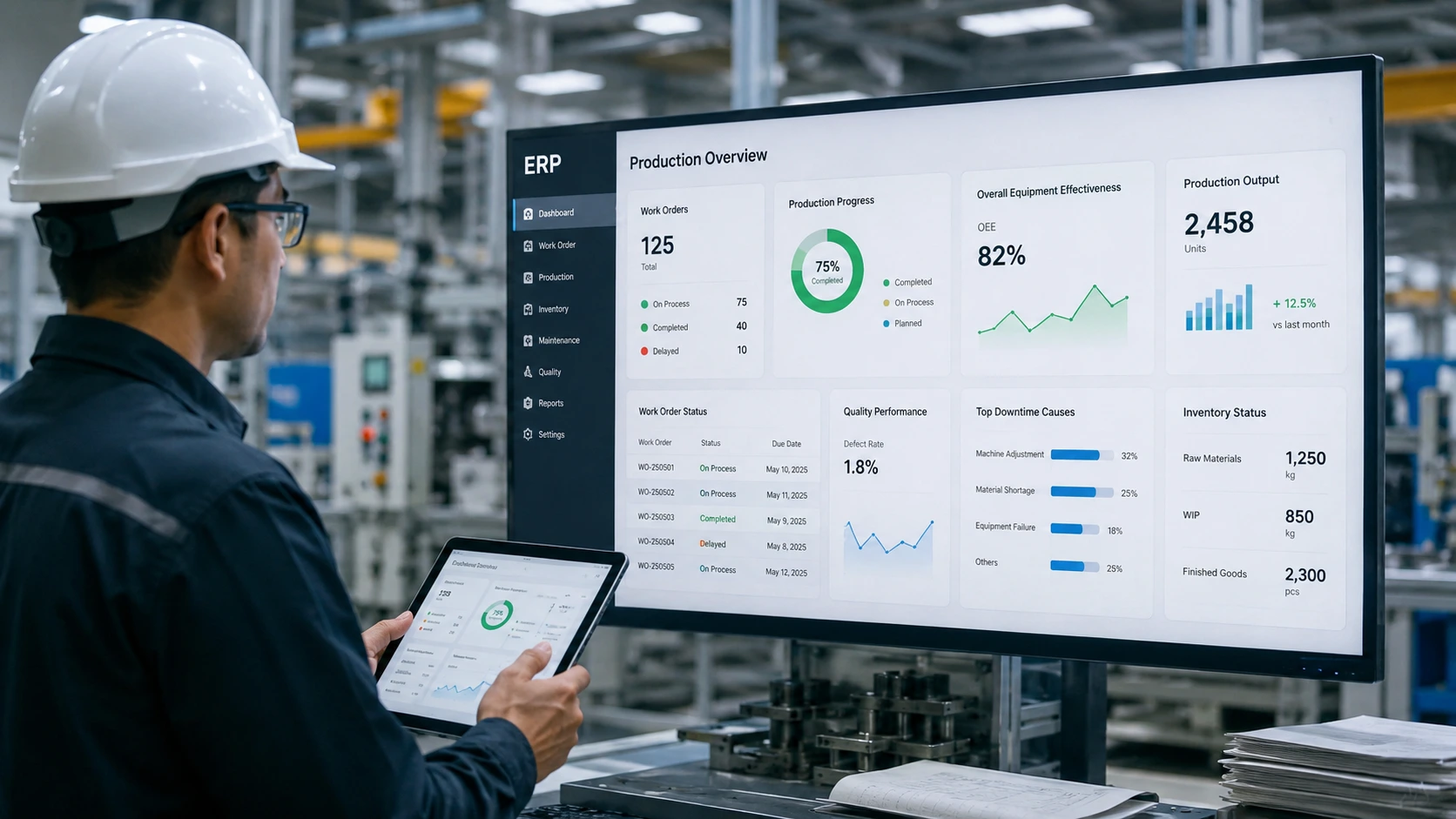
One of the biggest advantages of ERP over manual recording is the ability to monitor the status of work orders in real-time. Every status change—whether it is in progress, ongoing, delayed due to component shortages, or completed—is immediately recorded in the system and can be viewed by production managers, quality control teams, and procurement departments without having to wait for manual reports.
This visibility makes decision-making much faster. If a work order is delayed due to a machine issue, the maintenance team can be notified immediately. If there is a delay that impacts the delivery date to the customer, the sales team can be communicated with right away before the problem escalates.
“"What cannot be measured cannot be managed." This classic management principle is highly relevant in the context of modern production—and ERP is the tool that makes real-time measurement possible, not just end-of-month reports.
3. Reduce Production Waste
Waste in production is not only in the form of discarded raw materials but also includes waiting time, defective products (rejects), rework, and overproduction that does not match demand. Without well-recorded data, such waste is often unrecognized as it is considered "ordinary operational costs."
ERP allows for the recording of waste at every stage of production—from the actual consumption of raw materials compared to the plan, the number of rejected products per line, to the reasons for rework. This data can then be analyzed to identify patterns: whether waste occurs due to the quality of raw materials from a specific supplier, due to operator errors in certain shifts, or because machines need recalibration.
With a data-driven approach like this, companies can implement lean manufacturing principles more concretely—not just as a slogan, but supported by accountable and actionable numbers from the relevant teams.
4. Production Line Efficiency
The efficiency of the production line is greatly influenced by how balanced the workload is among workstations and how minimal the machine downtime is. An ERP system with a good manufacturing module can automatically record Overall Equipment Effectiveness (OEE), setup time, and downtime for each machine through integration with the recording system on the production floor.
From this data, management can see which production line is the bottleneck, which machine experiences the most frequent breakdowns, and which shift has the lowest productivity. This information serves as the basis for improvement decisions, whether in the form of rescheduling, operator training, or preventive machine maintenance integrated with the maintenance module in the ERP.
Alert: A production line that appears "busy" is not necessarily efficient. Without accurate OEE and downtime data, companies risk misjudging the performance of the production line and making incorrect decisions regarding new machine investments.
5. More Optimal Production Capacity
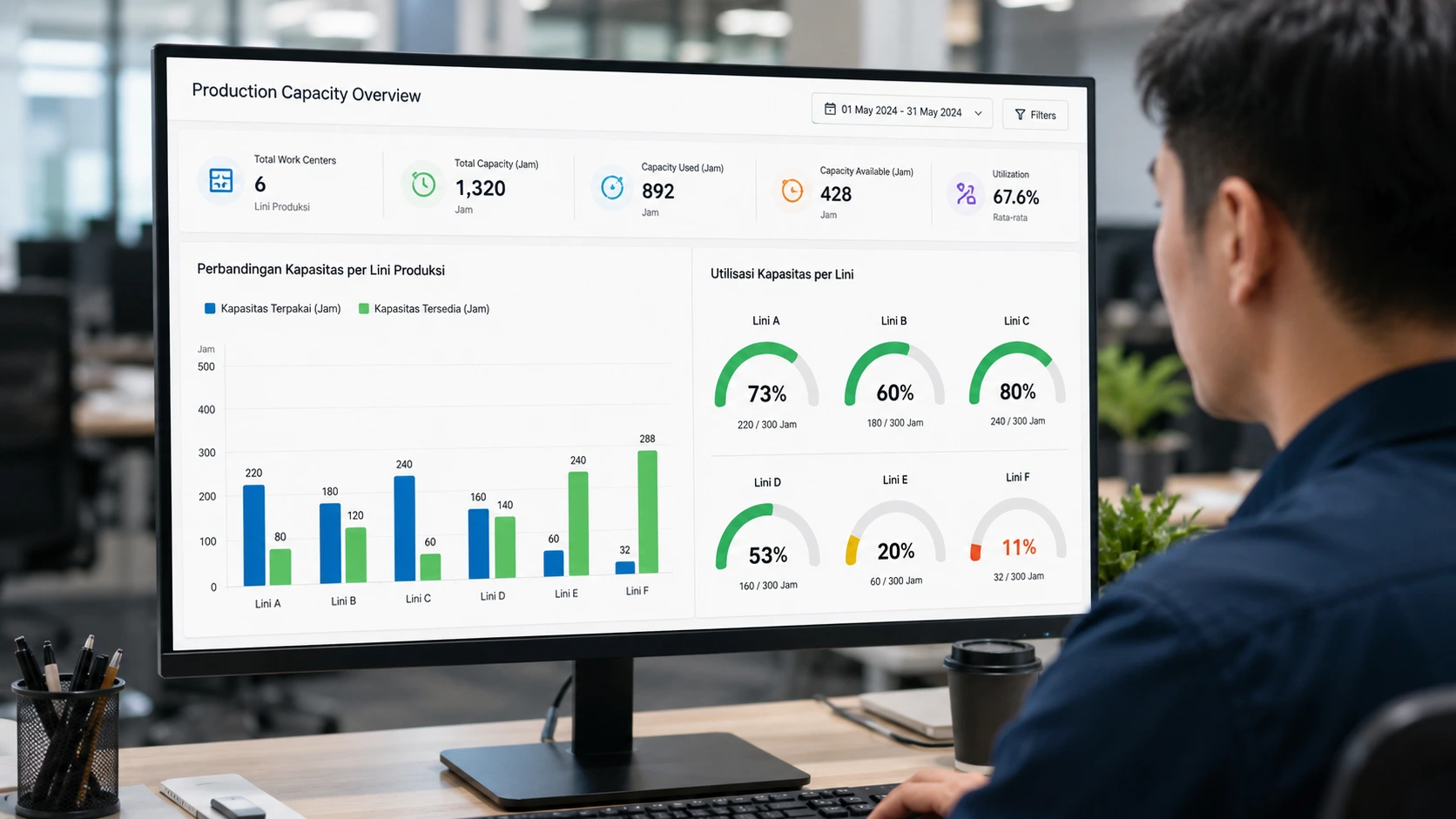
Production capacity planning often presents its own challenges, especially when demand fluctuates or when a company manages multiple lines or several factory locations simultaneously. ERP helps management calculate actual capacity based on machine working hours, labor availability, and the capacity of raw material and finished goods warehouses.
With this capacity simulation, the company can answer strategic questions with greater confidence: is the current capacity sufficient to handle the next large order, when is the right time to add work shifts, or which line should be prioritized to avoid both excess and shortage of capacity. Decisions based on simulation and historical data carry far less risk compared to decisions based solely on the intuition of production managers.
It's Time to Switch to More Measurable Production Management
The five areas above—production planning, real-time work order monitoring, waste reduction, production line efficiency, and capacity optimization—are interconnected. When one area improves, the others typically experience positive effects as well. This is why manufacturing companies, both medium and large scale, are increasingly turning to ERP systems to manage their production.
However, the success of ERP production implementation does not only depend on the selection of software, but also on how the system is configured to align with the real business processes in the field. This is where guidance from an experienced implementation partner becomes crucial, ensuring that the transition from a manual system to ERP proceeds smoothly without disrupting ongoing production operations.
If your company wants to have more planned, measurable, and efficient production management through ERP, our team is ready to assist from needs consultation, system demo, to full implementation.
Consult your Production ERP needs with Fujicon Priangan Perdana. Contact us:
- WhatsApp: +62 811-2227-5222
- Email: info@fujicon-japan.com
Experience how ERP can transform the way your team manages production from being assumption-based to data-driven.