

In the last two years, almost all manufacturing companies in Indonesia have experienced the same thing: raw material prices fluctuating without a clear pattern. The prices of steel, plastic, paper, chemicals, and even electronic components can change within weeks, driven by the exchange rate of the rupiah, global commodity prices, logistics costs, and supplier policies.
For the purchasing and production teams, this condition has become routine. However, for the director and finance manager, the question is much more fundamental: does the Cost of Goods Sold (COGS) that has been used to determine the selling price still reflect the actual cost conditions?
Small changes in material prices may seem trivial at first glance, but they can significantly erode margins if not promptly reflected in the cost of goods sold (COGS) calculations. For instance, a 5% increase in raw material prices can cut product profit margins by half, depending on the company's cost structure. This is where the urgency arises: companies that still rely on manual calculations risk selling products below their actual costs without realizing it.
This article discusses how to accurately calculate the cost of goods sold (COGS) amidst market price fluctuations, the challenges commonly faced by manufacturing companies, and how digital systems can help maintain the accuracy of production cost data sustainably.
What is the Cost of Goods Manufactured (COGM)?
Cost of Goods Manufactured (COGM) is the total cost incurred by a company to convert raw materials into finished goods that are ready for sale. COGM includes all costs directly and indirectly involved in the production process, from materials, labor, to factory operational costs.
The main purpose of calculating the Cost of Goods Sold (COGS) is not just for accounting needs, but as a basis for business decision-making. COGS serves as a reference for determining a fair selling price, calculating profit margins, evaluating production efficiency, and preparing accurate financial reports.
When COGS is calculated accurately, companies can set competitive yet profitable selling prices. Conversely, incorrect COGS will have a cascading effect on margins, net profit, and strategic decisions such as investing in new machinery or expanding production capacity.
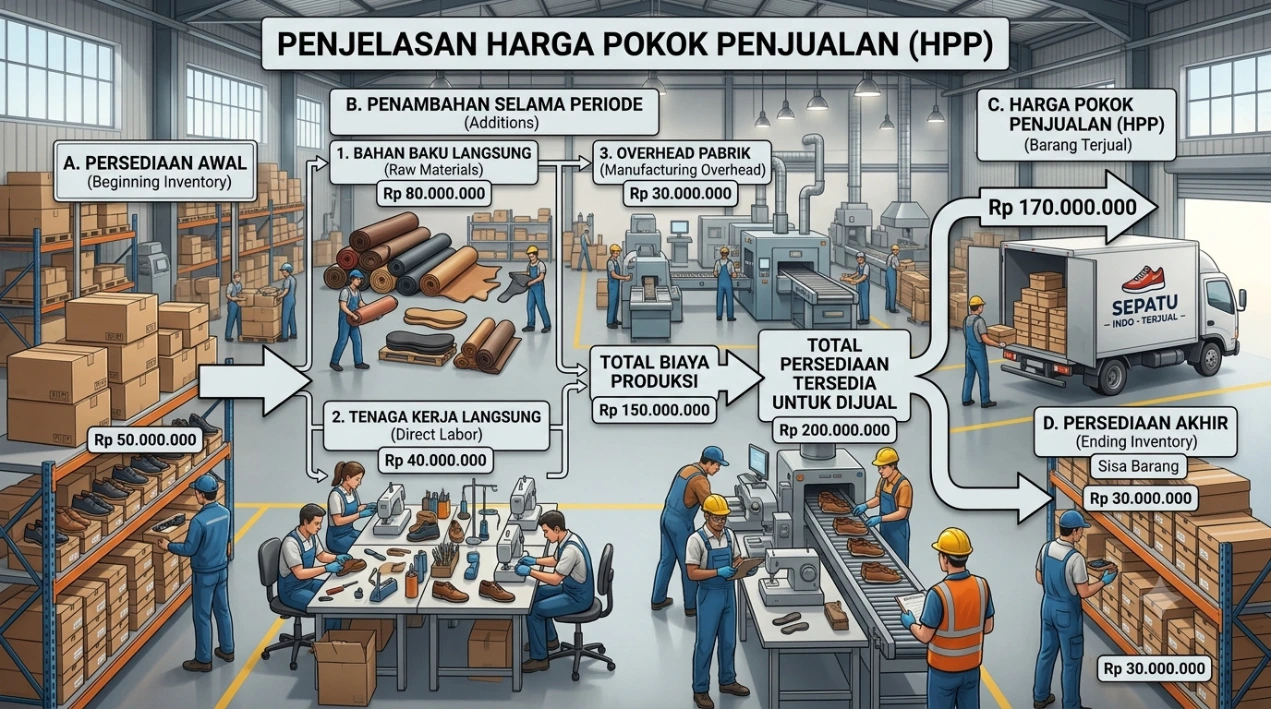
Components of HPP
In general, manufacturing cost consists of three main components.
1. Direct Material Costs
The cost of direct materials is the value of all materials used directly in the production process, such as fabric for garments, resin for plastics, or steel plates for metal components.
2. Direct Labor Costs
Direct labor costs include the wages of production operators, factory workers, and employees directly involved in the product manufacturing process, including overtime if applicable.
3. Factory Overhead Costs
Factory overhead costs include indirect expenses such as electricity, machine depreciation, maintenance, production supervision costs, and indirect auxiliary materials that do not become part of the finished product.
As a simple illustration, if a product requires raw materials worth Rp50,000, direct labor of Rp20,000, and overhead allocation of Rp10,000, then the cost of goods sold (COGS) per unit of that product is Rp80,000. This figure then becomes the basis for determining the selling price and the desired margin for the company.an.
Challenges in Calculating COGS When Market Prices Are Unstable
The calculation of COGS that appears simple on paper becomes much more complicated when market conditions are dynamic. Some of the most common challenges faced by manufacturing companies include:
- The price of raw materials fluctuates in a short period, so the cost of goods sold (COGS) calculated last month may no longer be relevant.
- Currency exchange rate changes, especially for companies that import raw materials or components from abroad.
- The increase in transportation and logistics costs adds to the landed cost of raw materials but is often overlooked in the calculation of the cost of goods sold (COGS).
- The supplier may change prices at any time, without sufficient prior notice to the purchasing department.
- Waste or raw materials that are discarded during the production process, which adds to real costs but is rarely recorded consistentlyen.
- Changes in energy costs, such as electricity rates or fuel for production machinery.
- Changes in labor costs, such as due to an increase in the minimum wage or sudden overtime needs.
Common case that often occurs: a plastic component factory purchases plastic pellets at a certain price at the beginning of the month, then compiles the cost of goods sold (COGS) and determines the selling price based on that figure. Two weeks later, the price of plastic pellets rises by 8% due to fluctuations in global oil prices. If the company does not promptly update the COGS, the products sold at the old price will generate a margin that is much thinner than the target, and may even result in a loss.
Risk If HPP Calculation Is Not Accurate
The inaccuracy of COGS is not just an administrative issue, but a real business risk. Some of the most common impacts include:
- The selling price is too low because it does not reflect the current production costs, so the company is actually selling with a margin lower than expected.
- Profit margins gradually decline unnoticed by management, as cost differentials continue to accumulate over time.
- Sometimes, business decisions are made, such as continuing the production of products that are no longer profitable.
- Error in creating a quotation for a new customer, which risks binding the company to a contract with unrealistic pricing.
- The financial report is less accurate because the inventory value and cost of goods sold do not reflect the actual condition.
- It is difficult to evaluate production efficiency because there is no cost data that can be consistently compared across periods.
The impacts are generally not immediately visible, but accumulate and are only realized when the company's profits decline without a clear reason.
Why Spreadsheets Often Become a Hindrance?
Many manufacturing companies in Indonesia still rely on spreadsheets to calculate COGS. This method is indeed quite flexible in the early stages, but it has several fundamental weaknesses as the business grows and cost variables become more complex.
First, data is often scattered across many different files owned by the purchasing, warehouse, production, and accounting teams, making it difficult to consolidate consistently. Second, formulas in spreadsheets can easily change or break without notice, especially if worked on by more than one person.
Third, human error becomes a risk that is difficult to avoid, ranging from incorrect price input to incorrect calculation formulas. Fourth, the process of updating raw material prices takes time because it must be done manually one by one across various sheets.
Fifth, and most crucially, the spreadsheet is not real-time and is not directly connected to purchasing, warehouse, production, and accounting data. As a result, the COGS generated often reflects past costs rather than the current cost conditions at the time the selling price decision is made.
How ERP Helps Generate More Accurate COGS
The manufacturing ERP system is designed to address these limitations by connecting all business processes within a single integrated system. Some key capabilities relevant to the accuracy of COGS include:
Purchasing integration ensures that every price change from suppliers is directly recorded in the system and automatically affects the calculation of raw material costs, without the need for manual updates in multiple places.
Inventory integration allows the inventory value to be continuously updated based on the latest purchase prices, including valuation methods such as FIFO or Average Cost.
Bill of Materials (BoM) becomes a standard production recipe that defines the composition of raw materials, labor, and overhead for each product, ensuring that the cost calculation is consistent and structured.
The Manufacturing Order records the actual consumption of raw materials on the production floor, including variances or waste, so that actual costs can be compared to standard costs.
Real-time costing allows the system to automatically recalculate the cost of goods sold (COGS) as soon as there is a change in raw material prices, without waiting for the monthly closing process.
Landed cost ensures that additional costs such as shipping fees, import duties, and insurance are included in the value of raw materials, not just the purchase price from the supplier.
Automatic valuation and stock movement maintain the accuracy of inventory value every time there is a movement of goods, whether from purchases, production, or sales.
Accounting integration connects all direct production cost transactions to the accounting journal, so that the financial statements reflect the actual cost conditions.
The profitability analysis of products provides a real-time view of the margin per product, helping management identify which products are still profitable and which need to be re-evaluated.
As an illustration of the data flow, when the purchasing department buys raw materials at a new price, that data automatically enters the inventory and updates the stock value. When the raw materials are used in a manufacturing order, the system calculates the actual consumption based on the Bill of Materials (BoM) and the current prices. The final results are directly reflected in the Cost of Goods Sold (COGS) report and the financial statements, without the need for manual reconciliation from various sources.
Simple Case Study
As an illustration, a furniture manufacturing company uses processed wood as its main raw material. In the first month, the price of processed wood is Rp15,000 per kilogram, and the cost of goods sold (COGS) for the work desk product is calculated at Rp450,000 per unit with a selling price of Rp650,000.
One month later, the price of processed wood rose to Rp17,500 per kilogram due to supply constraints from suppliers. If the company is still using spreadsheets, this change may only be detected during the monthly recap process, causing the product to continue selling at the old price for several weeks and the margin to erode unnoticed.
With the ERP system, as soon as the purchasing department inputs a new purchase price, the system automatically recalculates the cost of goods sold (COGS) to approximately Rp487,500 per unit. The finance and sales teams immediately receive notifications that the product margin has decreased, allowing for quicker decisions on adjusting the selling price or other cost efficiencies before losses accumulate.
Tips for Maintaining HPP Accuracy
Regardless of the system used, there are several practices that can help companies consistently maintain the accuracy of COGS:
- Update supplier prices regularly, ideally every time there is a price change, rather than waiting for a monthly cycle.
- Use a clear Bill of Materials (BoM) standard for each product so that cost components can be easily traced.
- Record production waste regularly, as wasted raw materials still represent real costs that must be accounted for.
- Integrate purchasing with inventory so that changes in raw material prices are directly reflected in inventory value.
- Conduct cost evaluations regularly, at least once a month, to compare standard costs with actual costs.
- Use an integrated system between purchasing, inventory, production, and accounting so that cost data is always consistent and easy to monitor.
Conclusion
Calculating the cost of goods sold (COGS) accurately is no longer just an administrative necessity, but rather a fundamental foundation for maintaining the profitability of manufacturing companies in the midst of dynamic market conditions. The components of raw material costs, labor, and factory overhead must be monitored continuously, especially when material prices fluctuate due to factors such as exchange rates, logistics, energy, and supplier policies.
Manual calculations using spreadsheets have real limitations in terms of speed, accuracy, and data integration across departments. Manufacturing ERP systems emerge as a solution that connects purchasing, inventory, production, and accounting in a single data flow, allowing for real-time calculation of COGS and reflecting the actual cost conditions.
For companies looking to maintain competitiveness and profitability amid market price uncertainty, having accurate and easily accessible production cost data is becoming an increasingly important consideration. If your company is still relying on manual calculations and wants to explore how an integrated system can help make the costing process more accurate and efficient, this could be a good starting point to begin discussing it with your internal team or experienced ERP consultants.