

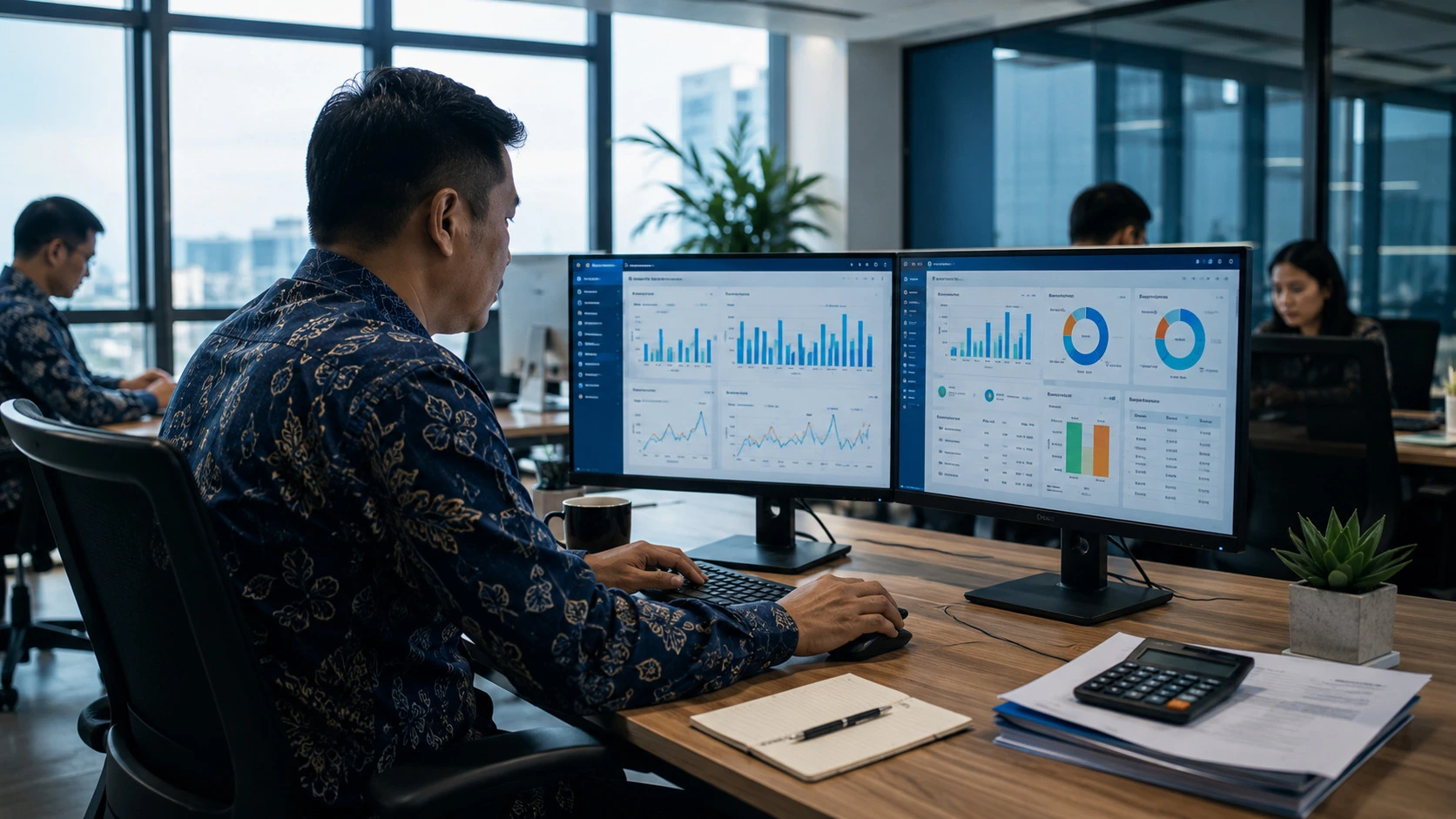
At the beginning of each month, the finance team is busy opening dozens of Excel files from various divisions. Sales data from the sales team is not synchronized with purchasing records. The warehouse department is still counting stock manually, while accounting is waiting for a recap from all parties before they can prepare the report. The monthly closing, which should be completed in a few days, ends up being delayed for two or three weeks.
For many owners and directors in Indonesia, this picture feels very familiar. Companies grow, transactions increase, new branches and warehouses are opened, but the financial recording system remains the same as it was five years ago. As a result, business decisions are often made based on outdated data, rather than the real conditions of today.
Such conditions are not a disgrace. This is a normal stage experienced by almost every growing company, from SMEs to medium-sized enterprises. The question is not whether this problem will arise, but when the company will realize it and take the right steps: switching to ERP.
"A good accounting system not only records transactions but also helps the company make decisions more quickly."
This article will discuss the five main signs that your company's accounting system is due for a transition to ERP (Enterprise Resource Planning), along with practical solutions that can be considered.
1. Too Many Manual Processes
The easiest sign to recognize is when almost all financial processes are still done manually. Sales data is re-entered into an Excel file, purchase invoices are recorded again in the accounting system, and reports are compiled by copy-pasting from one sheet to another.
Some impacts that usually arise from this condition include:
- Repeated input data. One transaction can be entered three to four times in different systems or files, by different divisions as well.
- Human error increases. The more manual input there is, the greater the chance of typos, incorrect formulas, or copying numbers incorrectly..
- Work time is wasted. Finance staff spend most of their time on repetitive administrative tasks, rather than on analysis.
- The team's efficiency is declining. Instead of focusing on financial planning and strategy, the team is busy organizing data.
A real example that often occurs: a distribution company with dozens of salespeople and hundreds of daily transactions still manually records sales at the end of the day. When there is a discrepancy between the sales report and the warehouse records, the team has to trace each physical receipt one by one to find the source of the error. This process can take days, even though it should be automatically detected by the system.
2. Financial Reports Are Always Late
The second sign is the monthly closing process that always runs behind schedule. Ideally, the monthly financial report should be completed within a few days after the end of the month. However, in many companies that still rely on simple accounting systems, the closing is only completed two to three weeks later.
Some common causes of this delay include:
- Data must be manually compiled from various sources before it can be included in the report.
- The accounting system used is not directly connected to daily operational transactions.
- Real-time reports are difficult to obtain because new data becomes "ripe" only after the manual reconciliation process is completed.
The impact on the business is quite significant. Directors and owners can only see last month's financial condition, not today's condition. Important decisions such as expansion, loan applications, or cost efficiency are often made too late because the supporting data is not available in a timely manner.
Tips: Accelerating the Closing Process Before considering a new system, first evaluate where the closing process most often gets stuck: is it in bank reconciliation, inventory recording, or accounts receivable validation? These bottlenecks are usually the clearest indicators that the company needs a more integrated system.
3. Non-Integrated Inter-Division Data
The third sign that often goes unnoticed is the inter-departmental data that operates independently. Accounting has its own records, purchasing has its own data, sales records in its own way, while inventory, production, and HR each use separate files or systems.
In fact, all of these divisions are actually closely interconnected:
- Sales generate sales data that affects inventory and production.
- Purchasing determines the availability of raw materials needed for production.
- Inventory affects accounting decisions in recording the value of inventory.
- HR contributes to the cost components that must be reflected in the accounting report.
When all these divisions are connected in one ERP system, data flows automatically from one process to the next. Sales transactions recorded by sales, for example, will automatically update inventory stock and be recorded as receivables in accounting, without the need for re-entry.

Alert: Risk of Disparate Data.
When data between divisions is not integrated, companies risk facing undetected stock discrepancies, duplication of accounts receivable or payable, and management reports that do not reflect the actual business conditions. This risk increases as the volume of transactions grows.
4. Difficult to Control Cash Flow and Profit
The fourth sign that directly impacts business health is the difficulty in monitoring cash flow, budget, outstanding invoices, and profit margins in real-time.
Some symptoms that are usually observed:
- The owner or director cannot see the current cash position without requesting a special report from finance.
- Budget by division or project is difficult to monitor, so cost overruns are only visible after everything has happened.
- Outstanding invoices or overdue receivables are not monitored automatically, resulting in frequent delays in billing.
- Margin per product, project, or branch is difficult to calculate because cost and revenue data is spread across many files.
ERP helps address this through a financial dashboard that displays cash position, receivables, payables, and margins in real-time. Management can view the business condition at any time, without having to wait for manual reports to be prepared first.
"Quick and accurate business decisions can only be made when financial data is available in real-time, not after it's too late."
5. Business Grows, but the System Does Not Evolve
The fifth sign usually appears when the business is actually in good condition: the company is growing, but the systems in use are lagging far behind.
Some of the indicators include:
- The addition of a new branch whose data is not automatically consolidated with the head office.
- The increasing number of warehouses makes stock tracking more complicated to do manually.
- Daily transaction volume continues to increase, while the capacity of the old system is limited.
- The number of users or employees is increasing, making the need for access rights and control more complex.
- A broad customer base demands a more streamlined sales and billing process.
Simplified accounting software is generally designed for smaller scale businesses with relatively simple processes. As business complexity increases, such software becomes a hindrance: the processes are slow, the reports are limited, and it cannot accommodate larger business structures.
Tips: Choosing the Right ERP. Choose a scalable ERP system, meaning it can add modules, branches, or new users without needing to replace the system from scratch. Also, ensure that the vendor provides implementation support, not just selling software licenses.

Why is ERP a Long-Term Solution?
After understanding the five signs above, the question is why ERP is the right answer, rather than just patching up problems one by one with separate tools.
Integrating all divisions allows data to flow automatically between business processes, eliminating repetitive input or data discrepancies between teams. Real-time data enables management to make decisions based on today's business conditions, rather than last month's reports. The management dashboard provides owners and directors with a comprehensive overview of the company's performance without the need to request special reports each time.
Business process automation reduces the administrative burden on teams, allowing work time to be redirected to more valuable activities such as analysis and planning. Scalability ensures that the system remains relevant even as the company adds branches, warehouses, products, or employees. Reducing human error maintains data accuracy, which ultimately increases management's trust in the reports generated. All of this leads to one main benefit: faster and more accurate business decision-making.
Here is a brief comparison between regular accounting software and ERP:
| Aspect | Regular Accounting Software | ERP |
|---|---|---|
Integration | Stand alone per division | Integrated across divisions (finance, sales, purchasing, inventory, production, HR) |
Automation | Most processes are still manual | Automated workflow from transaction to report |
Reporting | The report is prepared manually, often late | Real-time reports and dashboards |
Scalability | Limited to transactions/branches that are increasing | Must be able to grow in line with business growth |
Collaboration | Data is scattered, difficult to access across teams | A single data source that can be accessed by all divisions according to access rights |
Analytic | In-depth analysis is difficult to conduct | Integrated analytics and business intelligence support |
Case Study: Transformation from Traditional Accounting Software to ERP
A consumer goods distribution company in Indonesia (name anonymized) initially managed its finances using simple accounting software combined with dozens of Excel files to record inventory, sales, and receivables. With three warehouses and more than 50 field sales representatives, the data reconciliation process took nearly three weeks each month.
After analyzing its business needs, the company decided to switch to an ERP system that integrates all processes from sales, inventory, purchasing, to accounting into one platform. As a result, the monthly closing process, which previously took three weeks, was reduced to less than one week. The discrepancies in stock between warehouses, which often occurred before, were also minimized because every transaction is automatically recorded in real-time.
Equally important, management can now monitor cash, receivables, and margins by sales region at any time through the dashboard, without having to wait for manual reports from the finance team.
Conclusion
The signs that have been discussed, ranging from excessive manual processes, consistently late financial reports, unintegrated data between divisions, difficulties in controlling cash flow and profit, to systems that cannot keep up with business growth, are signals that need to be taken seriously by every owner, director, and finance manager.
Switching to ERP is not just about replacing accounting software with something more advanced. ERP is a system that integrates all business processes of a company, from accounting, sales, purchasing, inventory, production, to HR, into one interconnected platform. With this integration, companies can make decisions faster, more accurately, and based on data that is truly real-time.

PT Fujicon Priangan Perdana is an ERP implementation consultant in Indonesia that has assisted various companies from the manufacturing, distribution, retail, construction, F&B, services, and travel sectors in undergoing digital transformation through modern ERP solutions.
- Business needs consultation to understand the specific challenges of your company
- Analysis of business processes to ensure that the ERP solution aligns with existing workflows
- Comprehensive ERP implementation, from planning to go-live
- Training users so that the internal team can operate the system optimally
- Post-implementation support to ensure smooth system adoption
- Customization according to the needs and characteristics of your company's industry
If your company starts showing any of the five signs above, it is the right time to evaluate the systems in use. Contact PT Fujicon Priangan Perdana for consultation on implementing an ERP system that suits your business needs and scale.