

For an owner or project owner, building a building, factory, or infrastructure is not just about preparing funds and appointing a contractor. Without a good construction management system, a project that seems simple on paper can turn into a source of significant losses: inflated costs, schedules delayed by months, building quality not meeting specifications, and risks that arise along the way not being properly managed. This article discusses how owners can control four crucial aspects of every construction project, namely cost, time, quality, and risk, so that the investment made truly yields optimal results.
Why Owners Need to Understand Construction Management
Many owners believe that once the contract is signed with the contractor, the responsibility for project control fully shifts to the executing party. In fact, the owner's role is crucial to the success of the project from start to finish. Owners who understand the basic principles of construction management will find it easier to make strategic decisions, detect potential problems earlier, and communicate effectively with consultants, contractors, and the supervisory team in the field.
Good construction management serves as a bridge between the owner's desires and the execution capabilities in the field. Without this bridge, the gap between expectations and reality will widen as the project progresses.
Cost Control
Cost overrun is a nightmare feared by almost every owner. The causes are varied, ranging from design changes during execution, initial estimation errors, to weak control over variation orders. To effectively manage costs, owners need to ensure that the following aspects are carried out with discipline.
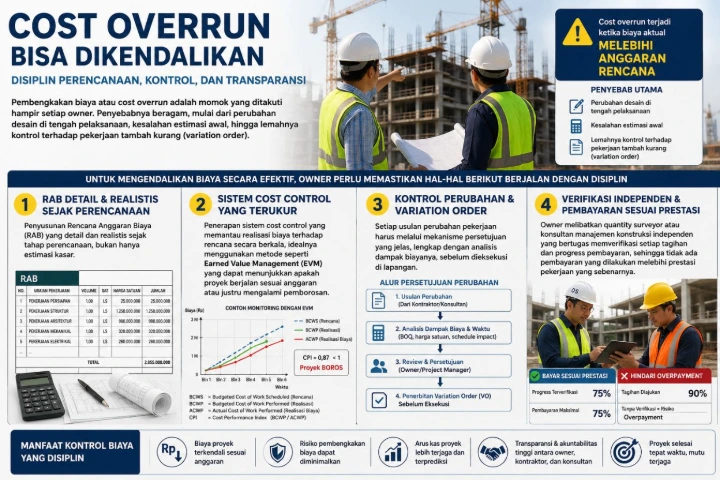 First, the preparation of a detailed and realistic Budget Plan (RAB) from the planning stage, not just a rough estimate. Second, the implementation of a cost control system that monitors the realization of costs against the plan periodically, ideally using methods such as Earned Value Management (EVM) that can indicate whether the project is on budget or experiencing overspending. Third, every proposed change in work must go through a clear approval mechanism, complete with a cost impact analysis, before being executed in the field.
The owner is also advised to involve a quantity surveyor or independent construction management consultant whose duty is to verify each invoice and payment progress, so that no payments are made beyond the actual work performance.
Time Control
Project delays not only harm in terms of time but also have a direct impact on costs, especially if the owner has specific operational targets such as the opening of a store, factory, or office building on a date that has been promised to other parties. Good time management begins with the preparation of a detailed implementation schedule or master schedule using methods such as the Critical Path Method (CPM), allowing the owner to identify which tasks are on the critical path and must not be delayed even slightly.
Selanjutnya, owner perlu meminta laporan progress mingguan atau bulanan yang membandingkan rencana (S-curve plan) dengan realisasi (S-curve actual). Jika terjadi deviasi negatif yang signifikan, owner bersama konsultan pengawas dan kontraktor harus segera menyusun rencana percepatan atau recovery plan, misalnya dengan menambah jam kerja, sumber daya, atau melakukan resequencing pekerjaan.
Regular coordination meetings between the owner, planning consultant, supervising consultant, and contractor are also very important to ensure that each party has a shared understanding of the project status and the anticipated steps moving forward.
Quality Control
Poor building quality has long-term impacts, ranging from high repair costs to safety risks for occupants or users of the building. Quality control is essentially divided into two complementary approaches: quality assurance (QA) and quality control (QC). QA focuses on the systems and procedures that ensure the work processes are correct from the beginning, while QC focuses on the inspection and testing of the work results in the field.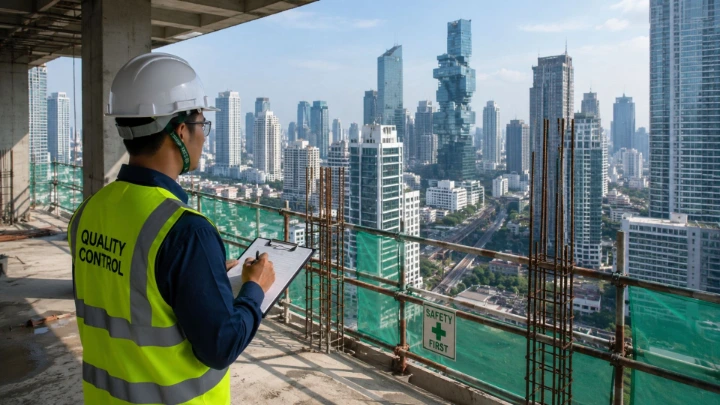
The owner needs to ensure that there are clear and measurable technical specifications in the contract documents, complete with material standards, work methods, and allowable tolerances. Incoming material inspections, sample testing such as concrete compressive strength tests, and inspections at each critical work stage (hold points and witness points) must be consistently carried out by a competent supervising consultant.
The application of quality checklists for each work item, as well as neat documentation in the form of daily and weekly reports, and progress photos, will be very helpful in the event of disputes related to the quality of the work results in the future..
Risk Management
Every construction project inevitably faces uncertainties, ranging from extreme weather, material shortages, regulatory changes, to soil conditions that differ from initial investigations. Good risk management begins with risk identification from the planning stage, followed by an analysis of the likelihood (probability) and impact on the project's cost, time, and quality.
The owner should prepare a risk register, which is a list of identified risks along with their mitigation strategies, and review it periodically throughout the project execution. Some common mitigation strategies include transferring risk through Construction All Risk (CAR) insurance, providing a contingency budget to anticipate unexpected costs, and having clear contract clauses regarding the division of responsibilities between the owner and the contractor in the event of unforeseen circumstances (force majeure).
Proactive risk management allows owners to make decisions more quickly when problems arise, rather than reacting reactively after the impact has already escalated.
Four Interrelated Pillars
It is important to understand that cost, time, quality, and risk are not four standalone aspects, but rather interrelated and influence each other. Accelerating the execution time without thorough planning can reduce the quality of the work. Arbitrarily cutting costs can increase the risk of construction failure. Therefore, an integrated construction management approach is needed, supported by a professional team that understands the interconnections among these aspects, so that all four can be managed in balance according to the priorities and conditions of the project.
It's Time to Trust Your Project to the Experts
Managing the four aspects mentioned above simultaneously is not an easy task, especially for owners whose primary focus is on their core business, not the construction world. This is where the role of a professional construction management consultant becomes very important, acting as a partner that represents the owner's interests on-site, ensuring that every dollar spent provides equivalent value, that each passing day brings the project closer to completion, and that every risk is managed before it turns into a major problem.
PT Fujicon Priangan Perdana is a trusted construction consultant with experience in helping owners control project costs, time, quality, and risks through a systematic construction management approach, supported by expertise in Building Information Modeling (BIM) technology for more accurate and efficient project planning and coordination. With a team of professionals and proven work methodologies, Fujicon is ready to be your strategic partner in realizing construction projects that are on budget, on time, and of high quality.
Don't let your construction project get out of control. Learn more about PT Fujicon Priangan Perdana's Construction Solutions services at fujicon-japan.com/solusi-konstruksi, or contact our team via WhatsApp at +62 811-2227-5222 or email info@fujicon-japan.com for further consultation regarding your project construction management needs.