

Introduction
The construction industry is undergoing a digital transformation that is moving much faster than many people imagined. In the past, 2D working drawings were considered sufficient as a standard for planning a building. Contractors would read the plans, sections, and details on paper, then envision how the final shape of the building would look.
Over time, the approach shifted towards a three-dimensional model through Building Information Modeling (BIM). Buildings are no longer just depicted, but digitally modeled complete with their technical data. Now, the transformation continues to an even further stage: a truly immersive experience through Virtual Reality (VR).
The question then arises naturally. How can a BIM model containing technical data transform into a virtual world that can be "entered"? What are the benefits for project owners who are risking a significant investment? And equally important, is VR just a cool-looking technology, or does it truly provide real business value?
This article will explore the journey of data from BIM to VR in a systematic and easy-to-understand manner, for both technical practitioners and non-technical readers.
What is BIM?
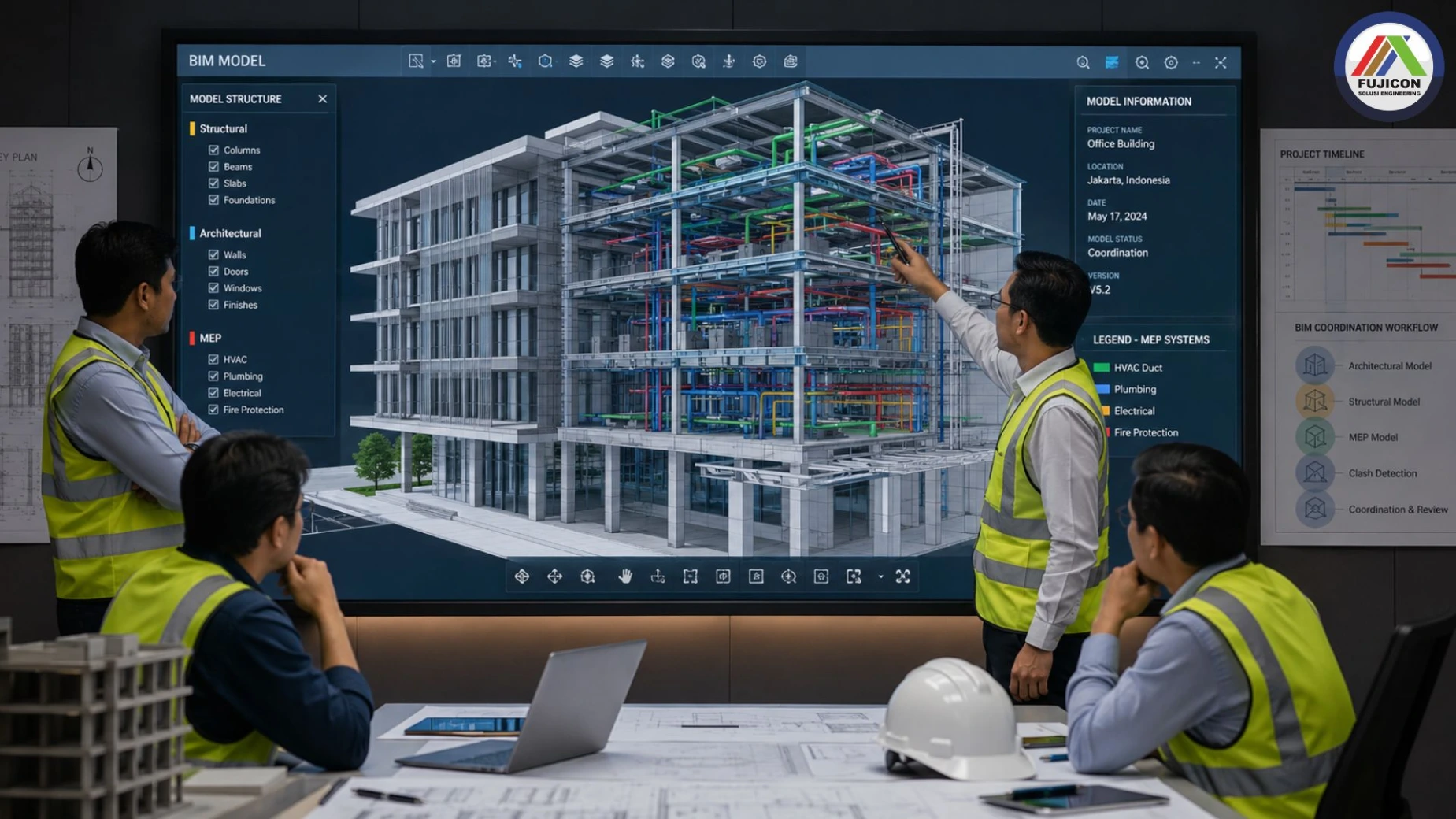
Building Information Modeling (BIM) is a digital working method that allows a building to be modeled in three dimensions while also being equipped with complete information behind it. BIM is not just a visually appealing 3D image, but rather a living database about the building itself.
Imagine BIM as the "medical record" of a building. Every element within it, from columns and beams to pipes, contains complete information just like a patient's health history record.
In a BIM model, various types of information are usually stored, including:
- Geometric data — the shape, size, and position of each building element.
- Material — type of material used in each component.
- Volume — the amount of material needed for cost estimation.
- Schedule — the relationship of elements with construction stages (4D).
- Component information — technical specifications for each element, from frames to AC units.
- Clash detection — automatic detection of collisions between elements, for example, a pipe penetrating a structural beam.
- Quantity — calculation of quantities to support the Bill of Quantity (BOQ).
- Metadata — additional information such as vendor, installation date, and warranty period.
In other words, BIM integrates design, technical data, and construction processes into a single model that can be accessed collaboratively by the entire project team.
What is Virtual Reality (VR)?
If BIM is the "brain" of building data, then Virtual Reality (VR) is the way to "experience" that data directly. VR allows a person to wear a headset and actually walk into a building that has not been built at all.
There is a fundamental difference between VR and other forms of visualization that you may already be familiar with:
- VR vs. regular 3D images — regular 3D images are static and can only be viewed from a fixed perspective, while VR allows users to move freely and look in all directions.
- VR vs. animated video — animated video has a predetermined (linear) storyline, while VR is interactive and directly controlled by the user.
- VR vs. Augmented Reality (AR) — AR adds digital elements to the real world (for example, through a phone camera), while VR completely replaces the real world with an immersive digital environment.
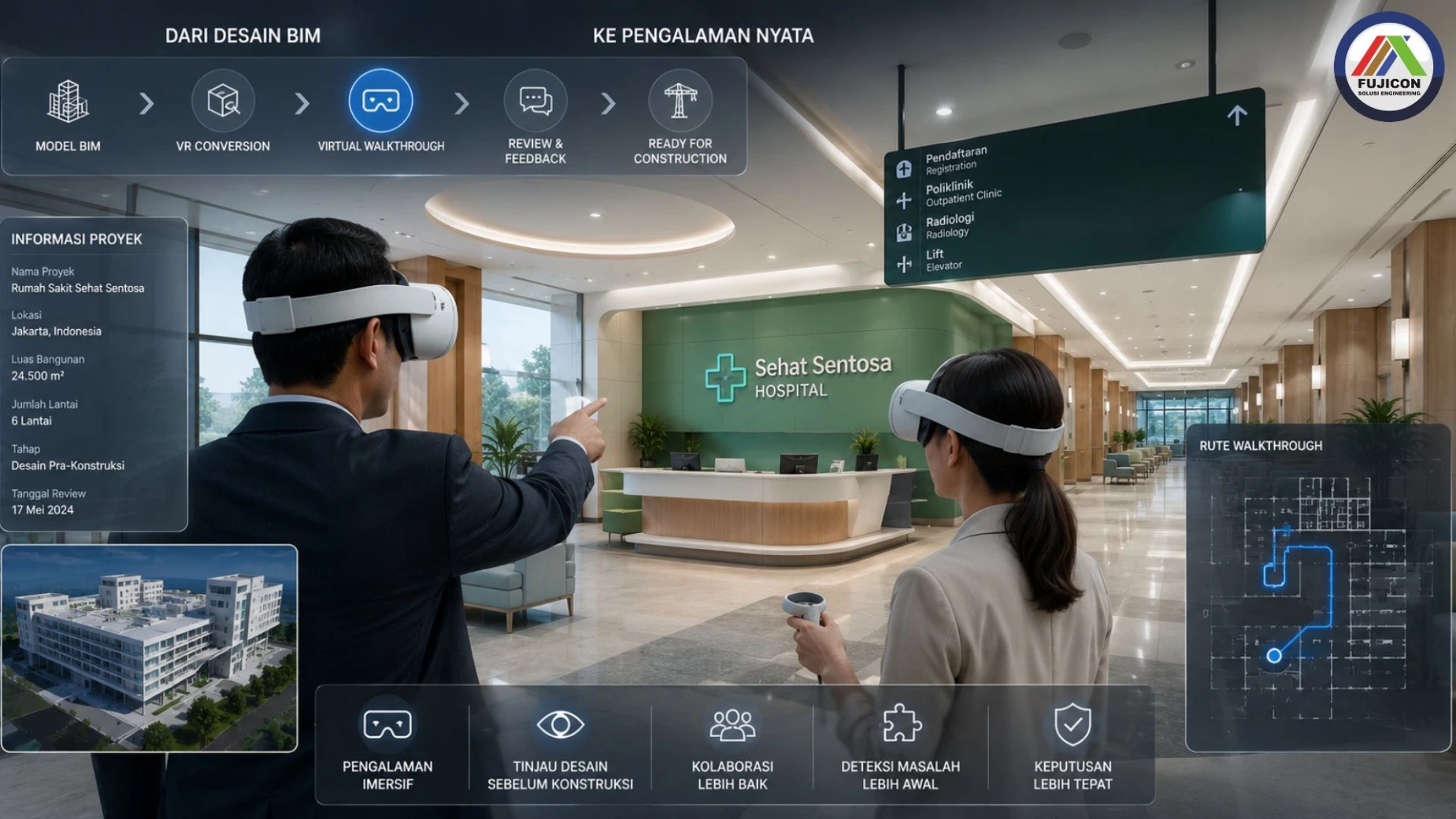
For example, a hospital director can wear a VR headset and "walk" through the corridors, waiting rooms, and even the operating room of a hospital that hasn't had a single brick laid yet. They can experience the scale of the space, the distance between rooms, and the lighting atmosphere — something that is hard to imagine just from a floor plan on paper.
How Does BIM Data Transform into VR?
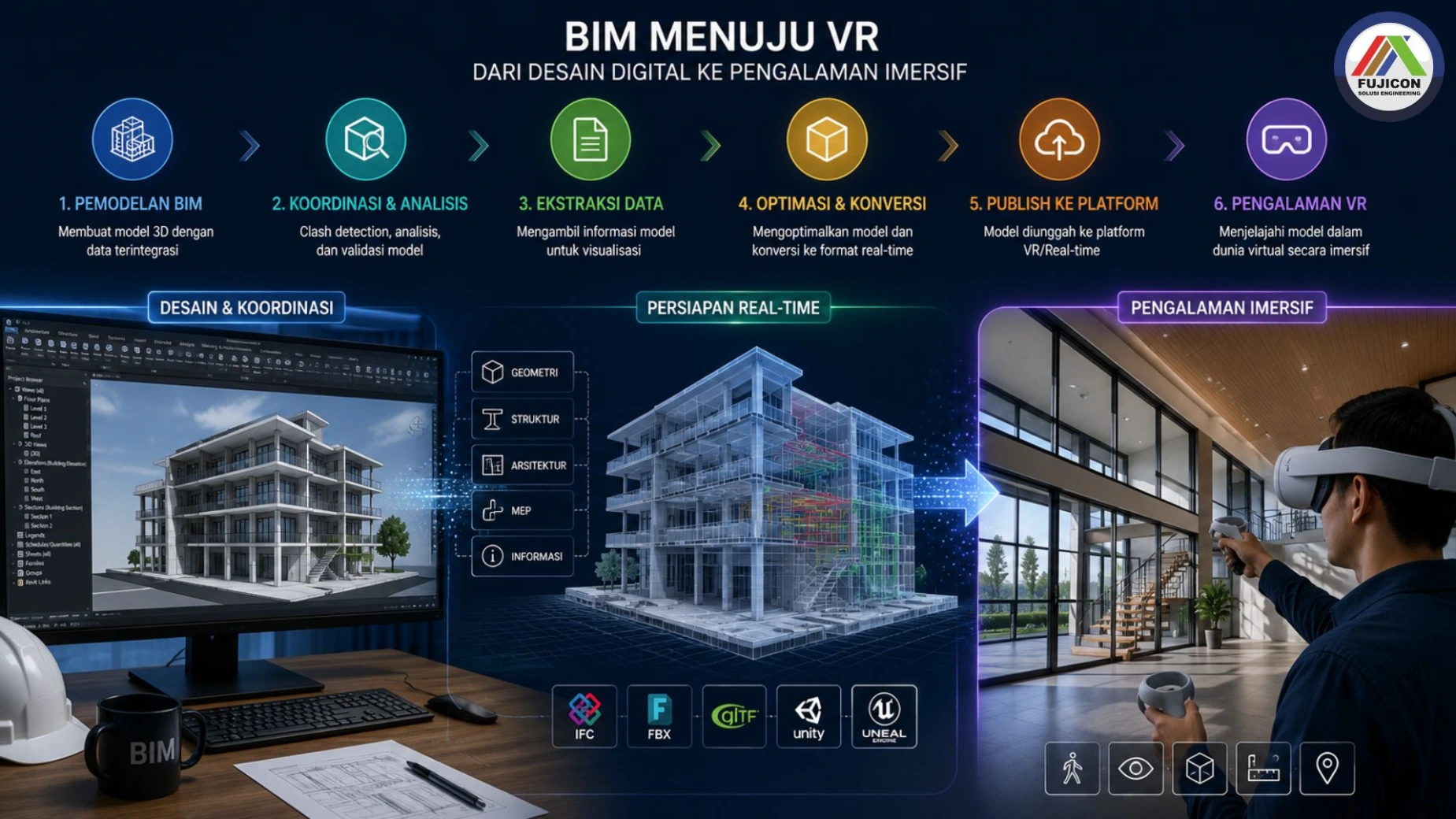
The journey from BIM data to VR experience goes through several interconnected stages:
CAD Design → BIM Model → Model Optimization → Rendering → Import to Game Engine → Virtual Reality
Here is a simple explanation of each stage:
- CAD design — the initial stage of designing building elements digitally, generally still in two dimensions or basic models.
- BIM model — design developed into a three-dimensional model integrated with data, typically using software such as Autodesk Revit.
- Model optimization — detailed BIM models are usually large, so they need to be simplified (this process is often referred to as optimization or decimation) to run smoothly in a real-time environment.
- Rendering — lighting, materials, and textures are refined to create a realistic appearance, using software such as Twinmotion or Enscape.
- Importing to the game engine — the model is then transferred to platforms like Unreal Engine or Unity, which are software originally developed for the gaming industry but are now widely used for architectural visualization.
- Virtual Reality — at the final stage, the model is run through a VR headset so that users can explore the building interactively and in real-time.
To check interdisciplinary coordination before the visualization stage, software like Navisworks is often used to perform clash detection first. It is not necessary to understand all the technical details of these software — what is important to understand is that each stage has its own role in transforming data into a visual experience that can be felt.
Benefits of BIM + VR for the Construction World
Presentation to the Owner is More Convincing
Owners no longer just imagine buildings from pictures, but can actually "step inside" them. This makes design presentations much more convincing and easier to understand, even for owners without a technical background.
Reducing Design Errors
Design errors that are difficult to see in 2D images, such as awkward space proportions or the positioning of elements that disrupt circulation, are much easier to recognize when viewed at full scale through VR.
Facilitating Decision Making
Stakeholders can provide feedback directly when viewing the model in real-time, making the discussion and design decision process faster and more efficient.
Accelerate Approval
When all parties have the same visual understanding, the design approval process tends to go faster due to minimal misunderstandings.
Evacuation Route Simulation
VR can be used to simulate evacuation routes and test whether the design meets safety standards before the building is actually constructed.
Building Operational Simulation
Operational flows, such as the movement of patients in hospitals or visitors in malls, can be simulated in advance to ensure spatial efficiency.
Helping Property Marketing
VR experiences can be used as a powerful marketing tool, allowing potential buyers to "visit" property units before the building is completed.
Reducing Revision Costs
Changes in design made early on, before construction begins, are much cheaper compared to changes made after physical work has started.
The faster stakeholders understand the design through real visual experiences, the smaller the potential for miscommunication that leads to costly revisions during construction.
Simple Case Study
A developer plans to build a new hospital. While reviewing the standard 2D drawings and 3D models, the owner feels that the entire design meets the needs and is ready to proceed to the construction phase.
However, when the model is placed into Virtual Reality and the owner "walks" directly inside it, several new issues become apparent:
- The waiting room feels smaller than expected.
- The patient pathway to the treatment room is not comfortable enough.
- The position of the main door actually obstructs evacuation access.
- The operating room is located too close to the public area.
Because this finding emerged before construction began, all changes can be made directly to the digital model without the need for physical dismantling. As a result, the revision costs that would have inflated can be completely avoided.
What Industries Are Suitable for Using BIM + VR?
The combination of BIM and VR is relevant for almost all types of medium to large-scale projects, including:
- Office building
- Hospital
- Hotel
- Airport
- Apartement
- Mall
- Industrial area
- Factory
- Data center
- Campus
- Smart city
The more complex the functions and circulation of a building, the greater the benefits that can be felt from the use of BIM and VR from the planning stage.
Implementation Challenges
Although the benefits are significant, the implementation of BIM and VR is not without challenges. Some things to consider include:
- Large file size — detailed BIM models require optimization processes before they can be run in real-time in VR.
- Hardware requirements — a computer and VR headset with adequate specifications are necessary for a smooth experience.
- SDM — a team that understands both the BIM process and the VR visualization process is needed.
- Standard modeling — BIM models need to be developed with consistent standards so that they can be further processed.
- Data coordination — data from various disciplines (architecture, structure, MEP) needs to be well coordinated.
- Initial investment — the implementation of this technology requires investment at the initial stage, both in terms of software and hardware.
It is Important to Note
Virtual Reality cannot provide an optimal experience if the BIM model has not been structured to a good standard. The quality of BIM data will greatly determine the quality of the visualizations and simulations produced..
Nevertheless, the long-term benefits gained — ranging from cost efficiency, decision-making speed, to minimal revisions — far outweigh the challenges that need to be overcome at the beginning of implementation.
The Future of BIM and VR
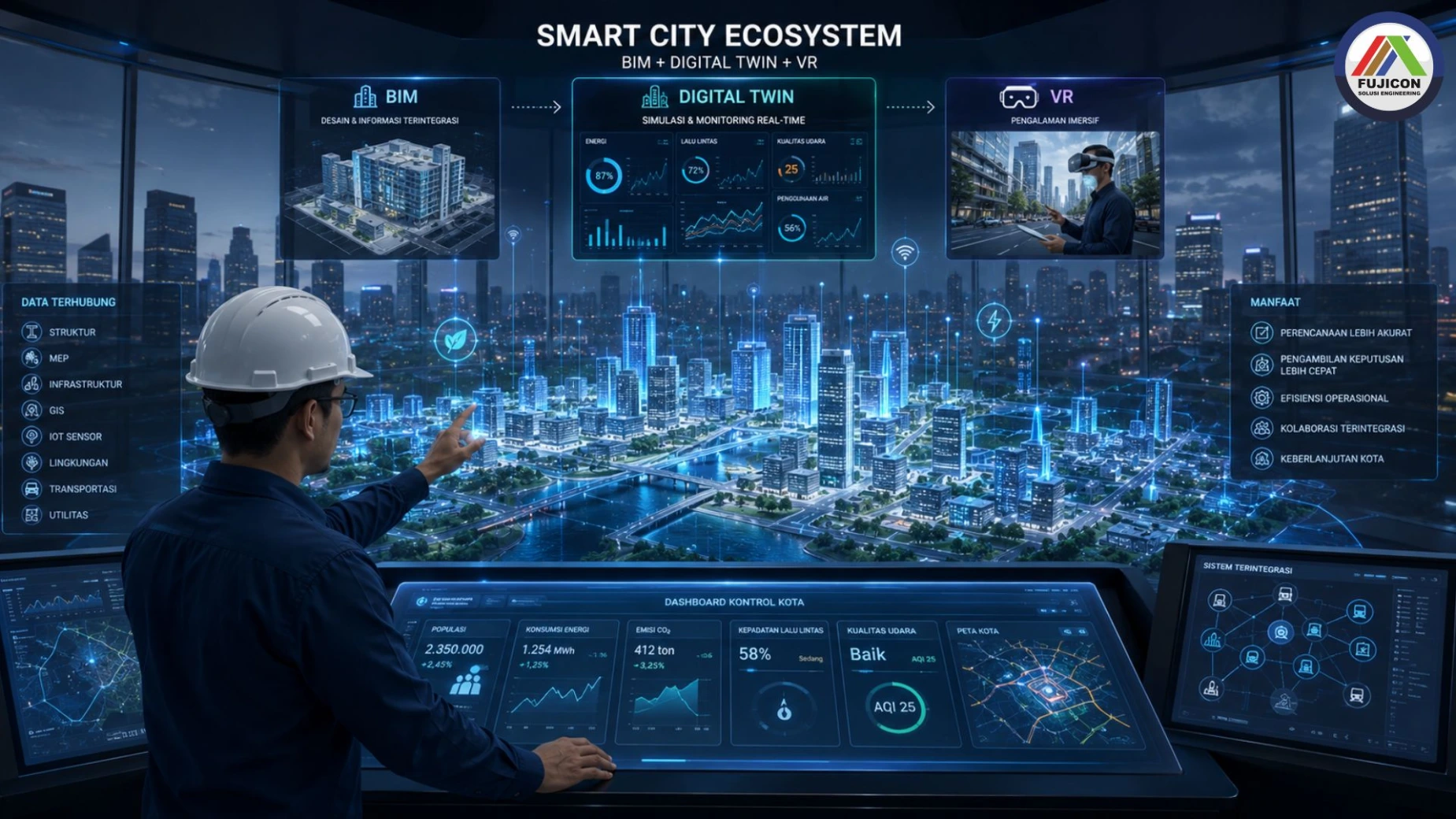
The development of BIM and VR does not stop at visualization alone. In the future, this integration will become increasingly connected with other technologies, such as:
- Digital Twin — a digital replica of a building that is continuously updated in real-time throughout its lifecycle.
- Artificial Intelligence — predictive analysis for design and operational efficiency.
- Smart Building — a building integrated with automation systems.
- IoT — sensors that are directly connected to the digital model of the building.
- Metaverse for construction — cross-location collaboration in a virtual world together.
- Remote collaboration — teams from different cities or countries can review the same project simultaneously.
- Cloud BIM — access model data from anywhere in real-time.
- Real-time project monitoring — project progress monitoring directly connected to field data.
In the future, the construction industry will increasingly rely on data integration and interactive visualization as part of standard operating procedures, rather than just an additional feature.
Conclusion
BIM is not just a way to create visually appealing 3D models. Behind it lies data that is far more valuable — and the value of that data multiplies when utilized through Virtual Reality.
With VR, all project stakeholders — from owners, architects, contractors, to project managers — can understand a building more realistically, long before the physical construction process begins. The integration of BIM and VR ultimately enhances design quality, accelerates communication among parties, reduces the potential for revisions, and supports more informed project decision-making.
Realize Your Company's Digital Transformation with Fujicon
Fujicon has experience supporting digital transformation across various industries in Indonesia. In addition to providing Building Information Modeling (BIM) solutions for the construction sector — ranging from clash detection, Detailed Engineering Design (DED), to Virtual Reality visualization — Fujicon also has capabilities as an ERP Odoo implementation consultant in Indonesia.
Through Odoo, Fujicon helps companies integrate business processes such as finance, purchasing, inventory, projects, HR, CRM, manufacturing, and operations into a single interconnected system.
If your company wants to discuss its digital transformation needs, whether from a BIM/VR or ERP perspective, the Fujicon team is ready to help develop a solution that suits your business needs.