

For manufacturing companies, a product is not just a finished good that comes off the production line. Behind it are hundreds of decisions: design revisions, changes in material specifications, engineering approvals, and cross-divisional coordination between R&D, purchasing, quality control, and production teams. When all these processes are managed manually or with separate systems, the risk of errors increases sharply — from outdated technical drawings still being used on the production floor to material changes not reaching the purchasing team in time.
This is where ERP for PLM (Product Lifecycle Management) comes in as a solution. By integrating product lifecycle management into a single ERP platform along with inventory, production, and financial data, companies can ensure that all parties are working from the same data source — accurate, real-time, and always the latest version.
What is PLM and Why Should It Be Integrated with ERP?
PLM (Product Lifecycle Management) is a systematic approach to managing the entire journey of a product — from concept, design, prototype, production, to post-sale and end-of-life. Traditionally, PLM often stands alone, focusing on technical data such as CAD drawings, bill of materials (BOM), and revision history.
The problem is, design data alone is not enough to run a business. Once the product is ready for production, the company still needs an ERP to manage raw material inventory, production schedules, costs, and shipping to customers. If PLM and ERP operate as two separate systems, data must be transferred or re-entered manually between systems — a slow and error-prone process.
📌 Note: Research in the manufacturing industry shows that most production delays are not caused by machines or labor, but rather by miscommunication of technical data between divisions — including the use of outdated design revisions.
With an ERP that has an integrated PLM module, design data, BOM, and engineering changes are directly connected to the production, purchasing, and inventory modules. No more manual data export-import processes, and no more gaps in information between divisions.
5 Key Benefits of ERP for PLM in Manufacturing Businesses
1. Manage Product Revisions Without Chaos
Every product inevitably undergoes revisions — whether due to design improvements, customer requests, or material adjustments. Without a clear system, the production team may unknowingly use outdated engineering drawings or BOMs, leading to defective products, waste of raw materials, and customer complaints.
With ERP for PLM, every product revision is recorded with a clear version numbering, complete with a change history (who changed it, when, and why). The system automatically ensures that only approved versions are available for use by the production team — thus, old revisions are automatically "locked" from active use.
⚠️ Alert: Using old images or BOM revisions on the production line is one of the most common causes of material waste and rework in the manufacturing industry. Ensure that your system has automatic version control, not just manual file naming.
2. Design Collaboration to Production in One Workflow
The product development process involves many parties: engineers who design, quality teams who set standards, purchasing teams who source materials, and production teams who execute. When each works with different tools and data, coordination becomes slow and full of miscommunication.
ERP with PLM modules allows the entire team to access the same product data in real-time — from technical specifications, approval status, to revision notes — all within a collaborative platform. The automated approval workflow also ensures that every design change goes through the proper review process before being forwarded to the production stage.

3. Comprehensive Product Life Cycle Control
One of the biggest advantages of integrating ERP and PLM is the full visibility into the product journey — from the initial idea, design, prototyping, mass production, to the post-sale phase and product end-of-life. Each stage is recorded with a complete audit trail.
This comprehensive lifecycle control is not just about efficiency, but also about compliance. For companies operating in sectors with strict regulations — such as automotive, electronics, pharmaceuticals, or food and beverage — full traceability of every product change becomes a mandatory requirement, no longer just an added value.
💬 Insight industri: "Companies that can digitally track the entire product lifecycle are generally better prepared for audits, warranty claims, and product recalls compared to those that still rely on manual documentation or scattered files."
4. More Managed Engineering Change (ECO)
Engineering Change Order (ECO) is a formal process for submitting, reviewing, approving, and implementing changes to product design. In many companies, this process is still carried out through email or paper memos — slow, difficult to track, and prone to being overlooked by the relevant divisions.
With ERP for PLM, each ECO is directly linked to the BOM, production routing, and even cost impact estimates before changes are approved. Once the ECO is approved, the system automatically updates related data and notifies the entire relevant team — from purchasing to warehousing — ensuring that there is no outdated material stock or incorrect specifications sent to customers.
⚠️ Alert: Skipping the formal ECO approval process often leads to the accumulation of unused material (obsolete inventory) — a loss that could actually be prevented with a structured and integrated ECO workflow.
5. Faster Product Innovation to Market
When all product data is integrated into one system, the new product development cycle becomes much shorter. The engineering team can iterate designs more quickly, the purchasing team can immediately calculate material cost estimates from the latest BOM, and the production team can prepare the production line as soon as the final design is approved.
This speed becomes a real competitive advantage. Companies that can shorten the time from idea to market (time-to-market) have a greater opportunity to respond to market trends, meet customer customization demands, and stay ahead of competitors that are still moving slowly due to complex data bureaucracy.
Key Features That Should Exist in ERP with PLM Module
When selecting or evaluating an ERP system with PLM capabilities, ensure that the platform has the following features:
- Version control and automatic revision for technical drawings, BOM, and product documents.
- The workflow of the Engineering Change Order (ECO/ECN) that is directly connected to production and purchasing data.
- Multi-level Bill of Material (BOM) that can be customized with product variants.
- Centralized document and image management, ideally with integration to CAD software.
- Tiered approval workflow according to the company's organizational structure.
- Automatic cost roll-up whenever there is a change in material or production process.
- Full traceability and audit trail from design to finished product.
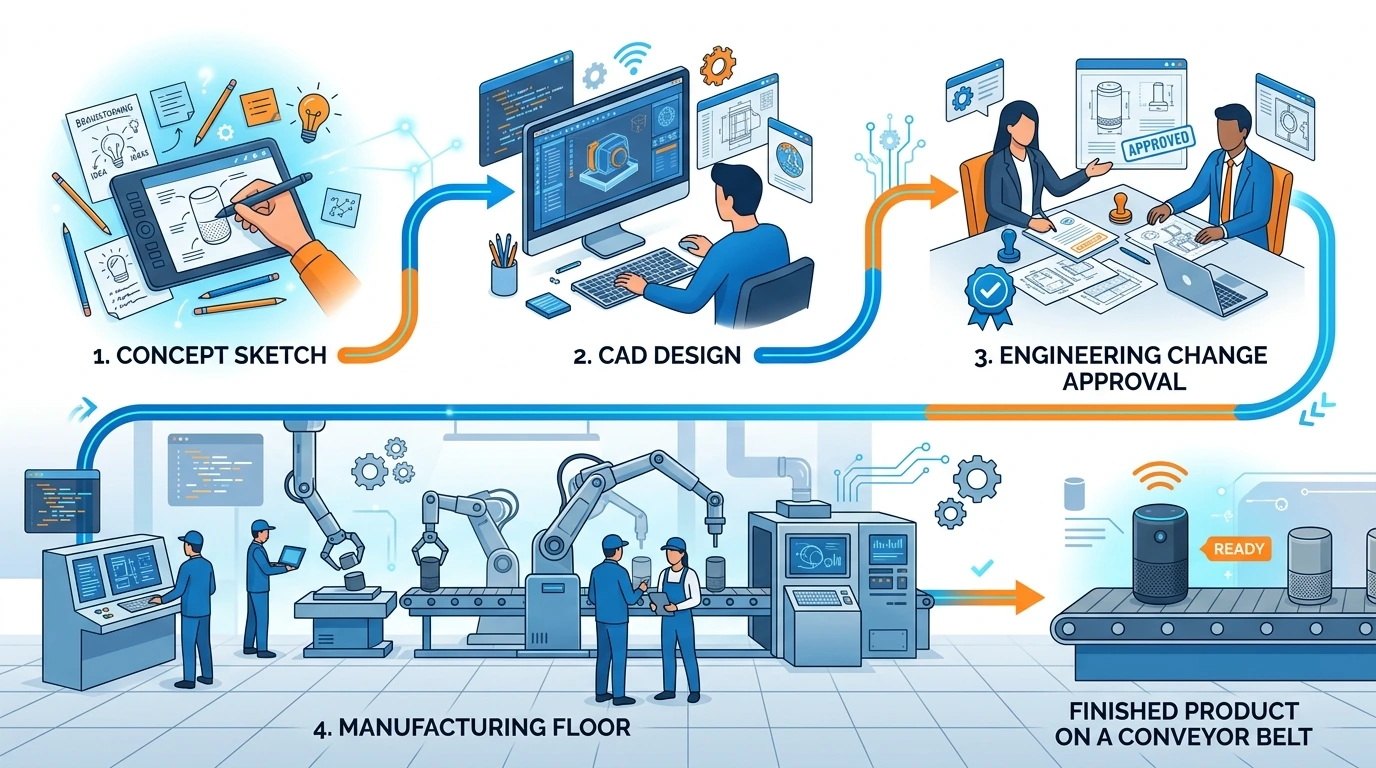
Simple Illustration: Real Impact on the Production Floor
Imagine a manufacturing company of electronic components that receives dozens of design revision requests from customers every month. Before using ERP with a PLM module, each revision had to be communicated manually via email to the production and purchasing teams — a process that took days and risked leaving some divisions without the latest information.
After ERP and PLM are integrated into a single system, each revision automatically updates the BOM and production routing, while notifying the relevant teams in real-time. The time previously required to align data, which took days, can now be reduced to just a few hours — simultaneously reducing the risk of production errors due to unsynchronized data.
Tips for Choosing an ERP with the Right PLM Module
- Ensure native integration, not just a separate plug-in that requires manual synchronization between systems.
- Test the approval workflow capability — ensure it can be adjusted to fit your company's approval structure.
- Note the ease of integration with the CAD software already used by the design team.
- Check reporting and traceability capabilities, especially if your business is in a heavily regulated industry.
- Choose an experienced implementation partner, as the success of ERP-PLM integration heavily relies on the correct configuration of business processes from the start.
Conclusion
ERP integration for PLM is not just a technology trend, but a fundamental necessity for manufacturing companies that want to remain competitive. With a single system that unifies product revision control, design-production collaboration, product lifecycle management, engineering change management, and accelerates innovation, companies can reduce errors, cut costs, and speed up the time to market for new products.
If your company is still relying on separate files, emails, or spreadsheets to manage product data, now is the right time to consider an ERP system that is truly integrated with PLM capabilities.
Ready to Manage Your Product Life Cycle More Efficiently?
Consult your ERP needs for PLM in your business with our team. We are ready to assist you from business process analysis to the implementation of a system that fits the scale and complexity of your products.
📱 WhatsApp: +62 811-2227-5222 🌐 Website: www.solusipintar.fujicon.id