
The monthly evaluation meeting should be a moment for making strategic decisions. However, in many companies, the meeting instead turns into a debate forum: the project team insists that the work progress is at 70%, while the finance team shows cost realization figures that far exceed the plan. The site manager has their own notes in a field book or personal spreadsheet. The headquarters has a different version in the accounting system. Individually, nothing is wrong, but the two are never truly synchronized.
This phenomenon has a name: data silo. And although it sounds like a technical term far removed from financial matters, its impact is very concrete — ranging from inflated project costs, delayed billing, to business decisions made based on outdated information.
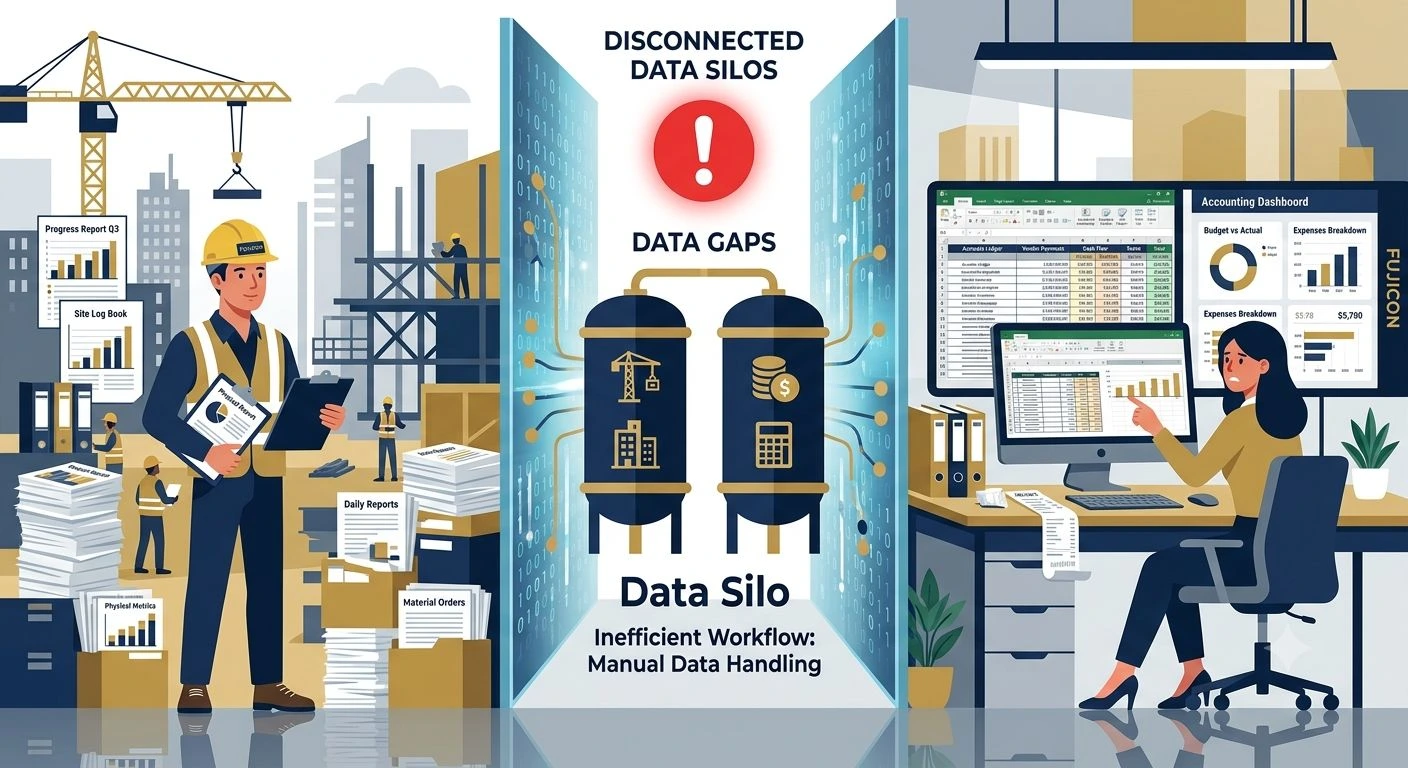
What Is a Data Silo, Really?
- Silo Physical Progress vs Financial Progress — the field team records progress based on the volume of work completed, while the finance team records based on invoices and payment milestones that have been disbursed.
- Silo Material & Bill of Quantity (BOQ) — actual material usage in the field often differs from the initial BOQ, but this discrepancy only becomes apparent after the project has progressed significantly, not at the time it occurs.
- Human Resources & Payroll Silo — attendance and overtime for field workers are recorded manually, then recompiled separately by HR at the headquarters before entering the payroll system.
"The company does not lose due to a lack of data. The company loses because it has too many conflicting versions of data, and none of them can be fully trusted."
Why Does This Data Silo Cause Financial Harm?
The losses due to data silos rarely appear as a single large, glaring number. They more often manifest as small leaks that occur repeatedly, at many points, throughout the project cycle — and their impact is only felt when the year-end financial reports are released.
3%–7%
Potential cost overrun due to undetected discrepancies between field and office data
2%–4%
Average delay week in the billing process due to manual reconciliation
30%+
The finance team's time is consumed only to reconcile cross-division reports
*Illustration of the range based on common patterns found in operational audits of medium-scale construction companies; actual figures vary depending on project complexity.
The data that is manually recorded in the field and then re-entered by the admin at the headquarters is not only time-consuming but also opens up the possibility of input errors, data loss, or even manipulation of figures that are difficult to trace back to their source.
Warning Signals to Watch Out For
If progress reports from the field and cost reports from finance always need to be "adjusted first" before they can be discussed in meetings, that is a sign that data silos have become entrenched in your company's business processes.
Silo Data vs Integrated System: A Real Comparison
| Aspect | With Data Silo | With an Integrated System (ERP) |
|---|---|---|
Data Source | Varies by division, often manual | A centralized, real-time database |
Reconciliation Time | For days to weeks | Hour counting, even automatically |
BOQ Difference Detection | It is known after the project has progressed far | Detected close to the time of the incident |
Decision-Making Basis | Assumptions & reports that have expired | Data can be audited at any time |
Admin & Finance Workload | High, many re-entries | Significantly reduced, workflow automation |
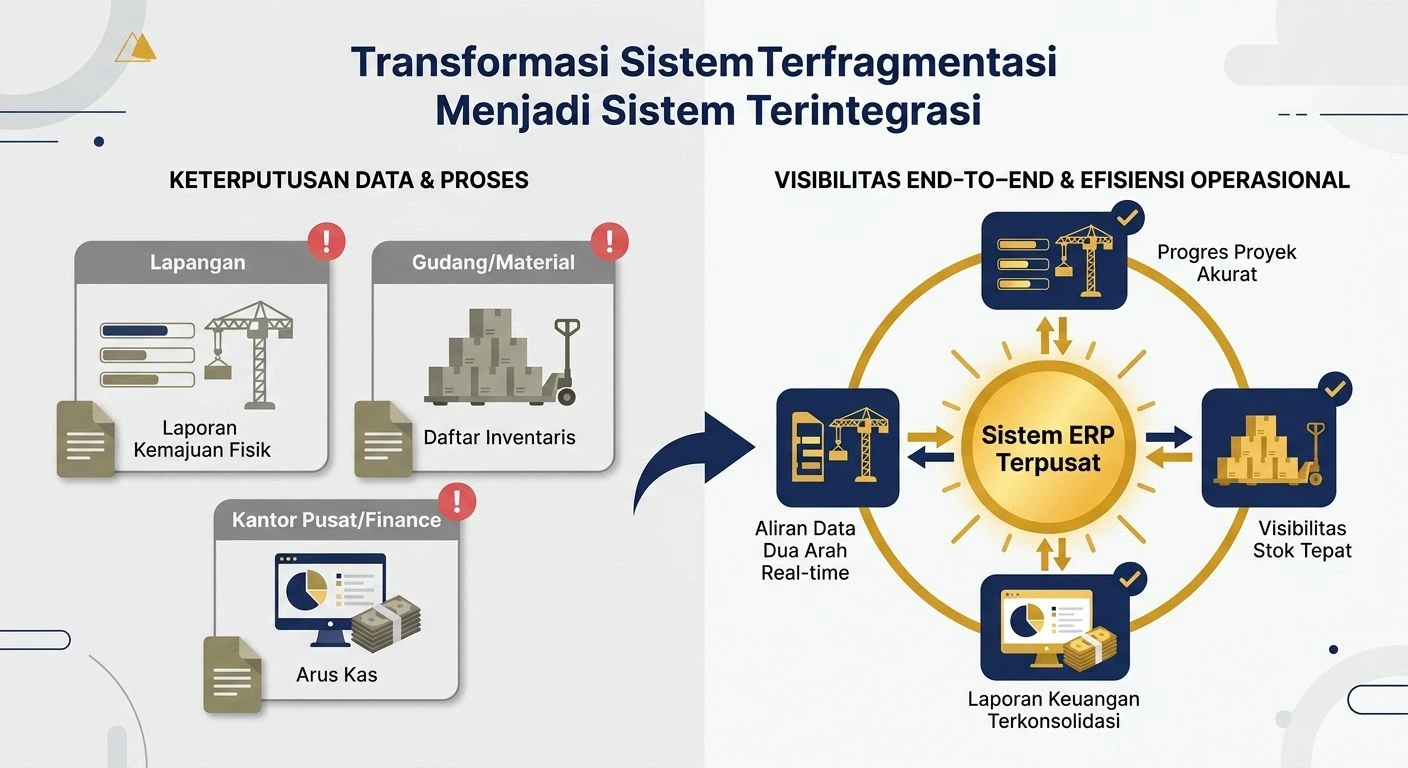
How Does Odoo ERP Bridge Field Data and Headquarters?
The solution to data silos is not just to ask teams to report more diligently, but to build a system that makes reporting automatic as part of the daily workflow. This is the role of ERP systems like Odoo in the context of construction and manufacturing companies:
- Project & Purchase Module Connected — every material request from the field is automatically recorded and linked to the project budget, allowing discrepancies against the BOQ to be monitored early on.
- Real-Time Cross-Division Dashboard — management can view physical progress, cost realization, and payment status in one view, without waiting for manual reports to be sent.
- Structured Approval Workflow — every change in workload volume or additional expenses goes through a neatly recorded approval process, reducing the room for errors or data manipulation.
- Integration with BIM Data — for companies that also implement Building Information Modeling, the volume of work data from the 3D model can be compared with the actual implementation in the field, enhancing the accuracy of BOQ audits.
Immediate Benefits
Companies that successfully connect field data and headquarters in one system generally report a much faster monthly closing process, as well as fewer discrepancies found during internal and external audits.
Practical Steps to Start Data Integration
- Current Data Flow Mapping — identifying points where field data and headquarters are still separated or manually input twice.
- Quick BOQ & Realization Audit — compare several recent projects to see the most common discrepancy patterns.
- Choose the Right System for Your Business Scale — ERP does not have to cover all modules at once; start with areas that have the highest financial risk, such as purchasing and project costing.
- Involve the Field Team from the Start — no matter how good the system is, it will not succeed if the field team is not trained and does not see the direct benefits of the data input they provide.
- Periodic Evaluation — use the available dashboard to regularly review project health, not just when problems have occurred.
Important Note
System integration is not a one-time project. Companies need to ensure there is a process for ongoing adoption and training so that the data entering the system remains accurate and consistent over time.
Closing the Gap, Not Patching Symptoms
Connecting field data and the headquarters in a single integrated system is not just an effort of digitalization, but a fundamental step to ensure that every business decision is made based on the actual conditions occurring in the field — not a version that has been delayed or distorted by manual processes.
It's Time to Unite Your Field Data and Headquarters
Fujicon Priangan Perdana helps construction and manufacturing companies integrate business processes through the implementation of Odoo ERP, supported by BIM solution expertise for better project data accuracy.
info@fujicon-japan.com
+62 811-2227-5222