

Many construction projects end up with cost overruns, delays, and even legal disputes — not because the contractors are incompetent, but because the planning documents were weak from the start. Detail Engineering Design (DED) is the root of it all.
Unfortunately, the Detail Engineering Design (DED) is often seen merely as a set of technical drawings that must be "finished first" before the project can proceed. In reality, the DED is the nervous system of a project. Without a proper DED, the Cost Budget Plan (RAB) cannot be trusted, the implementation schedule becomes a baseless estimate, and field supervision loses its reference.
What Is DED Actually?
Detail Engineering Design (DED) is a technical planning document that describes all aspects of a building or infrastructure in detail — from dimensions, materials, construction methods, to the technical specifications of each component. DED is not just a floor plan or elevation drawing. It includes:
- Architectural drawings — floor plans, elevations, sections, interior and exterior details
- Image of structure — foundation, columns, beams, floor slabs along with reinforcement
- MEP image — complete mechanical, electrical, and plumbing installation
- Technical specifications — material standards, concrete quality, type of steel, approved brands
- Bill of Quantity (BoQ) — a list of measurable and verified work volumes
- Cost Budget Plan (RAB) — cost estimation based on BoQ and unit price of work
In other words, the DED is a document that answers the questions: "What will be built, how will it be done, and what will it cost?" in a very detailed and measurable way.
Why is DED the Foundation for an Accurate RAB?
A good RAB is born from a good DED. This is not just a sequence of processes; it is the law of cause and effect in the construction world.
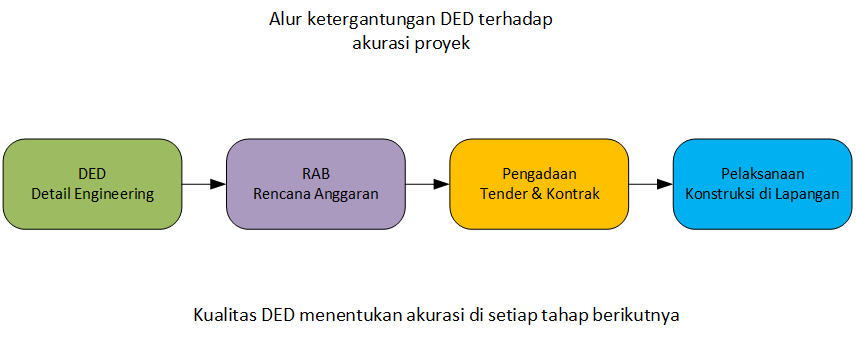
When the BoQ in the DED is inaccurate — for example, if the volume of earth excavation is underestimated, or the area of the painted wall does not include the atrium area — then the figures that go into the RAB are automatically incorrect. The contractor who wins the tender may recalculate on-site and find a significant discrepancy. This is where the requests for addendums, change orders, and cost overruns begin.
Did you know? According to various construction management studies, more than 60% of project cost overruns originate from incomplete or ambiguous DED documents, rather than from execution errors in the field.
The DED Components That Are Most Often "Underestimated"
Many clients and even consultants think that some parts of the DED can be done "later" or "adjusted in the field." In fact, these five components are the most common sources of problems:
Detail Connection Image
The connection of column-beam, welding, and bolts that are not detailed causes conflicts on site.
Soil Investigation
Incomplete geotechnical data makes the foundation design merely an assumption.
MEP Coordination
The pipe and cable that "collided" in the new image were discovered after the concrete had been poured.
Material Specifications
Without clear specifications, contractors are free to choose the cheapest materials that meet minimum requirements.
Implementation Method
Some specialized jobs (waterproofing, mass concrete casting) require documented methods.
Good DED = Legal Protection for All Parties
Great stories have characters. Try to create a great story that has characters, as crafting a great story for clients will help strengthen working relationships. Characters can emerge in small unique ways, such as word or phrase choices. Write from your own perspective, not through the lens of someone else's experience.
A great story is for everyone even if it is only written for one person. If you try to write for a wide audience, your story will come across as fake and empty. No one will be interested in reading it. Write for one person. If it feels sincere to one person, it will feel sincere to anyone.
— General principles of professional construction management
How Does DED Affect the Tender Process?
On the contrary, the vague DED invites different interpretations from each tender participant. One contractor might include the cost of formwork, while another assumes it is already included. The result: a Bid Price (BP) that appears "cheap" may not be due to efficiency, but rather because there are items that were overlooked — and will be charged back through a variation order.
Investment in DED: Expensive at First, Economical in the End
One of the biggest obstacles in realizing a quality Detailed Engineering Design (DED) is the perception that planning consultancy costs are too high. In fact, the logic is very simple:
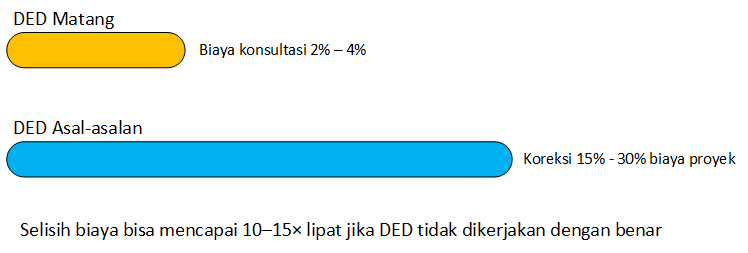
The cost of creating a comprehensive Detailed Engineering Design (DED) ranges from 2–4% of the project value. Meanwhile, costs for corrections, design changes in the field, and budget overruns due to poor DED can reach 15–30% of the project value. These are not fabricated numbers — this is a reality often experienced by projects in Indonesia.
Concrete Steps: Ensuring Your DED is of High Quality
If you are a project owner, developer, or budget manager, here are concrete things you can do:
- Choose an experienced planning consultant — don't just pick the cheapest one. Track record and portfolio are more important than price.
- Request a clear list of deliverables — the DED must include architectural drawings, structure, MEP, technical specifications, BoQ, and RAB. Ensure everything is included in the consultancy contract.
- Conduct an independent review — ask a supervising consultant or internal team to review the DED before entering the tender phase.
- Don't rush the planning phase — the pressure to start construction quickly often sacrifices the quality of the Detailed Engineering Design (DED). The "lost" time in planning actually saves time in execution.
- Interdisciplinary synchronization — ensure that the architectural, structural, and MEP drawings have been coordinated and that there are no conflicts before the documents are issued.
Conclusion: DED Is an Investment, Not an Expense
Start with the right plan, and good construction will follow.
Need Help Preparing DED & RAB for Your Project?
Our consulting team is ready to assist you in planning your project with precise, measurable, and tender-ready technical documents.